Key takeaways
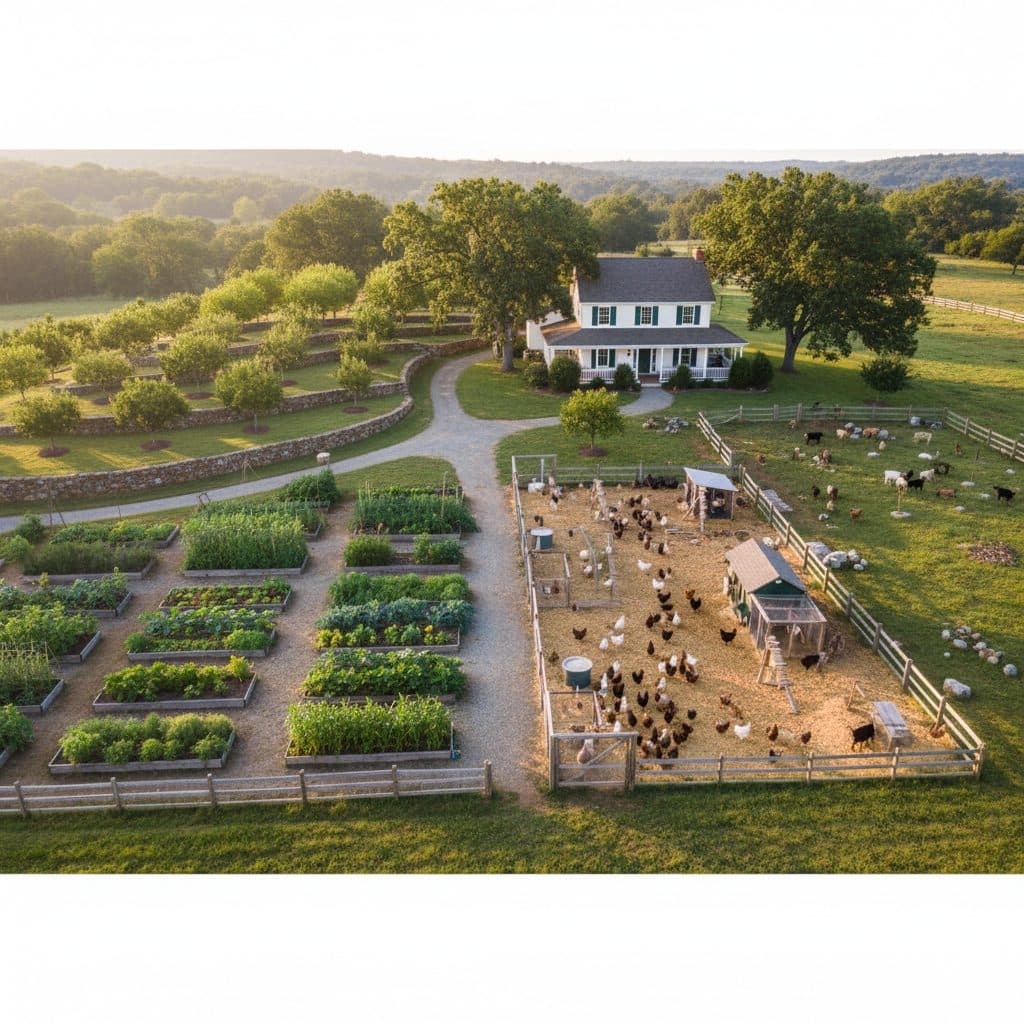
- Sizing a homestead depends on your specific self-reliance goals: vegetable production, egg laying, small dairy ruminants, or full livestock grazing.
- A quarter-acre (0.25-acre) suburban plot easily accommodates intensive raised beds, 4 to 6 laying hens, compost bins, and espalier fruit trees.
- One acre provides ample space for a complete family vegetable garden, 15 to 20 pastured chickens, an apiary, and a 10 to 15-tree home orchard.
- Two to three acres is the ideal minimum for adding small livestock like dairy goats, hair sheep, or heritage meat rabbits on rotational pasture.
- Five acres allows full family dairy self-sufficiency (one family milk cow or dairy herd), large-scale root cellaring, and a managed firewood woodlot.
- Ten or more acres is required for raising beef cattle, broad-acre grain production, or maintaining sustainable, off-grid timber heating.
Quick answer: You can homestead on as little as a quarter-acre (0.25 acre) for fresh vegetables, herbs, and backyard eggs. For high food self-sufficiency including meat, dairy goats, honey, and an orchard, 1 to 2 acres is ideal. If you plan to raise a family milk cow, beef cattle, or harvest your own firewood, look for 5 to 10 acres.
A practical question for aspiring homesteaders is how much land they actually need. Real estate listings often tempt buyers with cheap, remote parcels of 40 or 100 acres, while urban permaculture advocates demonstrate bountiful harvests from a standard suburban backyard.
The truth is that land size must match your operational capacity, budget, water supply, and dietary goals. More acreage does not automatically create a better homestead; unmanaged acreage quickly becomes overrun with invasive weeds, demands costly perimeter fencing, increases property taxes, and multiplies maintenance labor.
This practical sizing guide breaks down what is genuinely achievable on quarter-acre, 1-acre, 2-to-3-acre, 5-acre, and 10-plus-acre properties, helping you choose the right land footprint for your self-reliance goals.
+-------------------------------------------------------------+
|              HOMESTEAD SIZING BY PRODUCTION GOAL            |
|                                                             |
|   ACREAGE       PRIMARY CAPABILITIES      LIVESTOCK LIMITS  |
|   -------       --------------------      ----------------  |
|   0.25 Acre     Kitchen garden, dwarf fruit 4-6 Laying hens |
|   1.0 Acre      Family produce, orchard   15-20 Hens, bees  |
|   2 to 3 Acres  Full vegetable & small dairy 2-4 Goats/Sheep|
|   5.0 Acres     Milk cow, woodlot, grains 1 Cow + calves    |
|   10.0+ Acres   Beef cattle, timber heat  Rotational herd   |
+-------------------------------------------------------------+
What can you achieve on a quarter-acre (0.25 acre) homestead?
A standard suburban or semi-rural quarter-acre lot (approximately 10,890 square feet / 0.1 hectare) is more than enough space to produce a significant portion of a household's fresh food.
+-------------------------------------------------------------+
|              QUARTER-ACRE HOMESTEAD FOOTPRINT               |
|                                                             |
|   +-----------------------------------------------------+   |
|   | [House & Driveway]  (3,500 sq ft)                   |   |
|   | [Intensive Beds]    (1,200 sq ft - 6-8 raised beds) |   |
|   | [Chicken Coop & Run](300 sq ft - 4-6 hens)          |   |
|   | [Espalier Orchard]  (Fenceline dwarf fruit trees)   |   |
|   | [Compost & Shed]    (400 sq ft)                     |   |
|   | [Open Play Lawn]    (Remaining backyard space)      |   |
|   +-----------------------------------------------------+   |
+-------------------------------------------------------------+- Vegetable production: By using bio-intensive raised beds or no-dig methods, 800 to 1,200 square feet of cultivated garden space produces fresh salad greens, tomatoes, peppers, root vegetables, and herbs from spring to fall.
- Poultry: A small flock of 4 to 6 laying hens in a secure coop with a covered run produces 20 to 30 fresh eggs weekly, consuming kitchen scraps and garden weeds.
- Fruit trees: Grow 6 to 8 dwarf fruit trees along boundary fences: espalier apples and pears, and fan-train peaches, apricots, and cherries, which fruit on one-year wood and will not hold a formal espalier.
- Limitations: No room for grazing livestock, ruminants, or dedicated firewood production.
To evaluate zoning ordinances and property selection factors, review our guide to land for homesteading.
What is possible on a 1-acre homestead?
One acre (43,560 square feet) represents the classic homestead entry point. It provides complete independence from municipal grocery produce and eggs while remaining manageable by a single person or family.
+-------------------------------------------------------------+
|              ONE-ACRE HOMESTEAD CAPACITIES                  |
|                                                             |
|   FUNCTION                      FOOTPRINT ALLOCATION        |
|   --------                      --------------------        |
|   Main House, Garage & Yard     8,000 to 10,000 sq ft       |
|   Year-Round Vegetable Garden   4,000 to 6,000 sq ft        |
|   Standard 12-Tree Home Orchard 6,000 to 8,000 sq ft        |
|   Berry Brambles & Apiary       2,000 to 3,000 sq ft        |
|   Pastured Poultry & Coops      4,000 to 6,000 sq ft        |
|   Greenhouse & Nursery Shed     1,500 sq ft                 |
|   Open Lawn / Buffer Zone       Remaining space             |
+-------------------------------------------------------------+- Complete vegetable and storage independence: A 5,000-square-foot garden allows you to grow summer fresh vegetables as well as bulk preservation crops like winter squash, dry beans, onions, garlic, and storage potatoes to fill a root cellar.
- Substantial poultry operations: Manage 15 to 20 pastured laying hens and rotate two batches of 25 meat broilers in mobile chicken tractors each summer. Learn pastured systems in raising pastured chickens.
- Home orchard and apiary: Plant a multi-tier orchard of 10 to 15 semi-dwarf fruit trees, grape arbors, and raspberry/blackberry patches, alongside two to three honeybee hives for honey and pollination.
- Meat rabbits: House three breeding does and one buck in a well-ventilated hutch system, yielding well over 100 pounds of lean meat a year on a base of unlimited grass hay and a balanced rabbit pellet, supplemented with hand-cut garden greens and weeds. Never feed lawn-mower clippings; they ferment fast and cause fatal digestive upsets.
To explore foundational self-reliance definitions, read what is homesteading.
Why is 2 to 3 acres the sweet spot for small dairy ruminants?
Stepping up to 2 or 3 acres opens the door to dairy self-sufficiency and fiber production by providing adequate pasture for small ruminants without degrading soil.
+-------------------------------------------------------------+
|              TWO-TO-THREE ACRE HOMESTEAD ALLOCATION         |
|                                                             |
|   [ Home & Outbuildings ]   (0.5 Acre)                      |
|   [ Intensive Gardens & GH] (0.5 Acre)                      |
|   [ Orchard & Apiary ]      (0.5 Acre)                      |
|   [ Rotational Pastures ]   (1.0 to 1.5 Acres - 4 Paddocks) |
|   - Accommodates 2-4 Dairy Goats or Hair Sheep              |
|+------------------------------------------------------------+- Dairy goats or hair sheep: A standard stocking rate in regions with moderate rainfall (30+ inches annually) is 4 to 6 goats or sheep per acre of quality pasture. A 1.5-acre pasture divided into four rotational paddocks easily supports two milking Nigerian Dwarf or Nubian does and their kids, supplying fresh milk, yogurt, and cheese through most of the year. To milk right through, stagger kidding so one doe freshens while the other is dry.
- Heritage pigs: You can raise two feeder pigs from weaners to market weight (250 lbs) over five months in a half-acre wooded paddock or rotational pasture pen.
- Dedicated greenhouse: Space for a 14 x 30-foot unheated high tunnel extending fresh harvests through winter freezes.
When do you need 5 acres or more?
Five acres is widely regarded as the comprehensive family homestead scale, balancing total dietary self-sufficiency with realistic single-family management.
+-------------------------------------------------------------+
|              FIVE-ACRE HOMESTEAD INFRASTRUCTURE             |
|                                                             |
|   INFRASTRUCTURE                ACREAGE DEDICATED           |
|   --------------                -----------------           |
|   Residential Homestead Zone    0.75 Acre                   |
|   Gardens, Greenhouses & Barn   0.75 Acre                   |
|   Fenced Rotational Pastures    2.50 Acres (Cattle/Sheep)   |
|   Managed Firewood Woodlot      1.00 Acre (Sustainable heat)|
+-------------------------------------------------------------+- The family milk cow: A standard dairy cow (such as a Jersey or miniature Dexter) requires approximately 1.5 to 2 acres of productive pasture per cow-calf pair, along with dedicated winter hay storage. A Jersey in full lactation gives roughly 3 to 6 gallons a day; a Dexter (chosen precisely because a Jersey is more milk than one family can use) gives about 1.5 to 2.5. Either only milks after calving and needs a dry period of about two months before the next calf.
- Firewood self-sufficiency: A healthy, well-managed one-acre hardwood woodlot (oak, maple, hickory, beech; check what your state extension recommends for your region; ash stands are being lost to emerald ash borer and ash firewood cannot legally be moved across many state lines; black locust is invasive outside its native Appalachian and Ozark range) sustainably produces about half a cord to one cord of firewood per acre per year (more only on a productive, well-stocked site), providing heating fuel without depleting the forest stand.
- Water storage ponds and swales: Adequate footprint to construct a quarter-acre catchment pond, gravity-fed swale irrigation, and large composting operations.
When is 10+ acres necessary?
Ten or more acres is required when scaling into commercial farm enterprises or raising large grazing herds:
- Beef cattle production: Raising a small herd of 3 to 5 grass-fed beef steers requires 5 to 10 acres of rotational pasture, depending on soil quality and annual rainfall.
- Grain and field crops: Growing staple grains (wheat, barley, field corn) for animal feed demands mechanized field space.
- Timber buffer and privacy: Maintaining a dense wildlife corridor, hunting land, and extensive private off-grid buffers.
+-------------------------------------------------------------+
|              HOMESTEAD LAND SIZING SUMMARY TABLE            |
|                                                             |
|   HOMESTEAD SCALE     IDEAL FOR...             NOT FOR...   |
|   ---------------     ------------             ----------   |
|   0.25 Acre           Vegetables, Eggs, Herbs  Livestock    |
|   1.0 Acre            Full Gardens, Poultry,   Dairy Cows,  |
|                       Orchard, Rabbits, Bees   Beef Grazing |
|   2 to 3 Acres        Dairy Goats, Sheep,      Large Cattle |
|                       High Tunnels, Pastures   Herds        |
|   5.0 Acres           Family Milk Cow, Pigs,   Commercial   |
|                       Managed Firewood Woodlot Grain Crops  |
|   10.0+ Acres         Beef Cattle, Agroforest, Large Herds  |
|                       Off-Grid Buffer & Ponds  Solo Hand-Work|
+-------------------------------------------------------------+
To build the practical abilities needed to operate properties of any scale, explore our comprehensive index of essential homesteading skills.
By aligning your acreage purchase with your actual agricultural goals, you can choose a property that provides abundant food without overwhelming your family with unmanageable land.