Key takeaways
- Relay planting involves establishing a second crop into an existing one before the first is harvested, maximizing land use.
- This method can increase total biomass or yield per acre compared to single cropping, though the size of the gain depends on the crop pair and the climate.
- Careful planning of crop compatibility, planting times, and row orientation matters for success.
- Consider specific crop pairings like winter wheat and soybeans, or early corn and winter squash, tailored to your USDA zone.
- Manage challenges like water competition and nutrient depletion through efficient irrigation and soil testing every two to three years.
- Relay planting reduces weed pressure, improves soil health, and diversifies farm income over a single growing season.
Quick answer: Relay planting is a farming technique where a second crop is planted into an existing crop before the first is harvested, allowing both to share land for a period. This method increases effective land use by letting two crops share a field for part of the season, though the yield outcome depends heavily on the crop pair, the region, and how well the overlap is timed.
Relay planting comes out of row-crop agronomy. Most of what has been documented — including the wheat-and-soybean work below — is field scale, worked with combines and no-till planters, so the per-acre yield figures and equipment notes translate poorly to a homestead plot even though the principle does. Relay planting offers a strategic solution, allowing a second crop to establish itself before the first crop is fully harvested. It can raise total output from a field, though how much depends on the crop pair, the region, and the precision of the overlap.
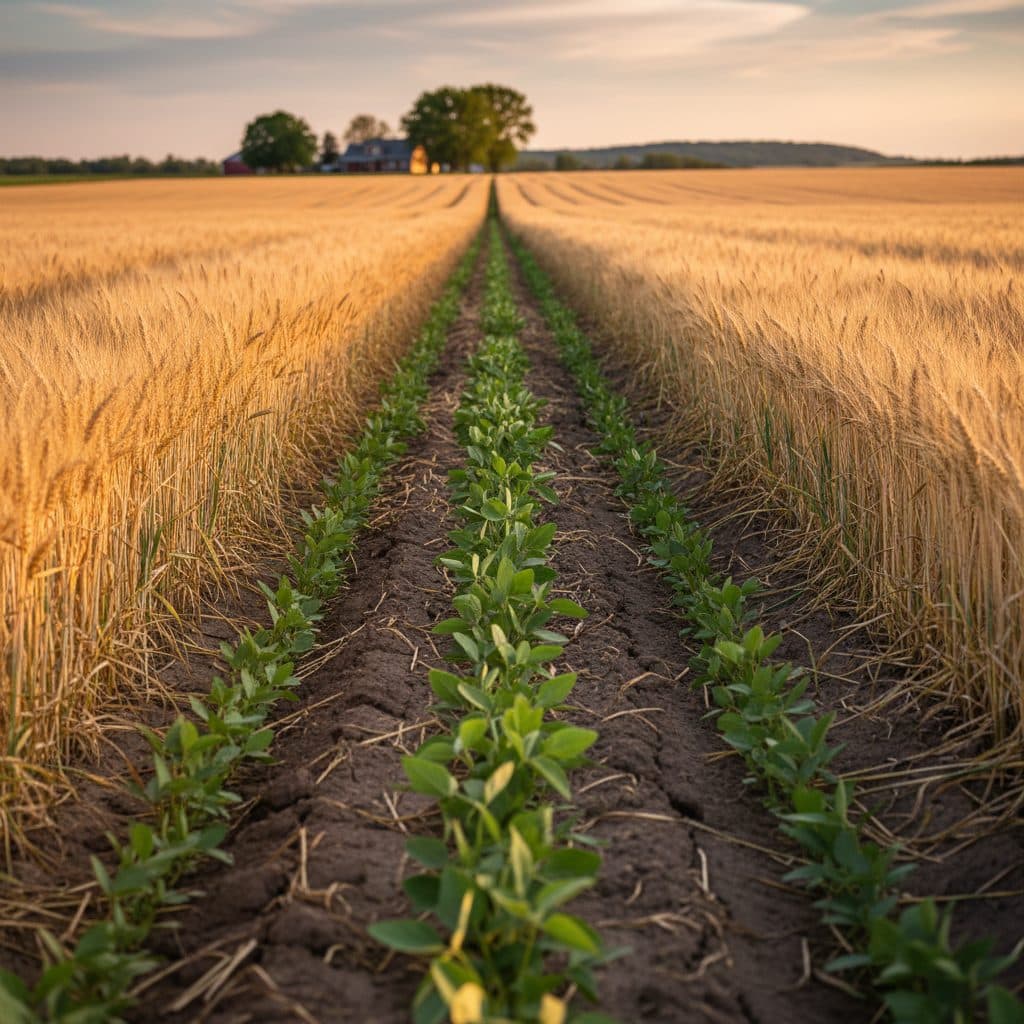
Unlike traditional succession planting, where one crop is completely removed before the next is sown, relay planting creates an overlap period. This overlap can extend the effective use of your land by weeks or even months. For example, planting soybeans into standing wheat a few weeks before the wheat harvest can add 20 to 30 days of growth for the soybeans, though the wheat typically gives up a little to wheel traffic and competition, and relay soybeans yield below a full-season crop.
What is relay planting?
Relay planting is a farming technique where a second crop is planted into a field before the first, established crop is harvested. The two crops share the land for a portion of their growth cycles, allowing for a more efficient use of space and time. This differs from intercropping, where two or more crops grow simultaneously for their entire duration, and from succession planting, which involves planting crops one after another with no overlap. For instance, in Ethiopia, studies have shown that relay intercropping white lupine into teff can increase overall yield by 30% compared to growing teff alone [1].
benefits of overlapping crops
The primary benefit of relay planting is the increased effective land use, since two crops draw on the same ground for part of the season. This approach can also help suppress weeds by maintaining continuous ground cover and improve soil health through diverse root systems. For example, a farmer in central Kansas might plant a cover crop like clover into corn fields when the corn is 2-3 feet tall, providing nitrogen fixation and weed control for the subsequent cash crop. This strategy can reduce how much nitrogen the following cash crop needs.
- maximizes growing season length by starting the second crop before the first comes off.
- can raise total output per acre when the crop pair and timing suit the site.
- reduces weed pressure by maintaining continuous ground cover.
- improves soil structure and organic matter content over time.
- diversifies farm income and reduces risk from single-crop failures.
Planning your relay system
Successful relay planting hinges on careful planning, especially regarding crop selection and timing. You need crops that are compatible in terms of growth habit, nutrient needs, and light requirements during their overlap period. A classic pairing in many US regions is winter wheat and soybeans. Research from 1993 highlighted the importance of row orientation and planting patterns for relay intercropped soybean and wheat, showing that specific configurations could optimize yields [4]. For example, planting soybeans in 30-inch rows into 7.5-inch wheat rows can provide enough space for soybean establishment.
crop selection and timing considerations
Timing is perhaps the most critical factor. The second crop must be planted early enough to establish itself before the first crop’s canopy completely closes, but not so early that it competes too aggressively. For winter wheat and soybeans, soybeans are typically planted when the wheat is in the soft dough stage, which is about two to three weeks before wheat harvest in USDA zone 6. This allows the soybeans to begin their growth cycle with sufficient light and moisture. Consider crops with different root depths to minimize competition for water and nutrients, like shallow-rooted lettuce under taller, deeper-rooted tomatoes. For more ideas on beneficial plant pairings, consider exploring companion planting strategies.
- select crops with complementary growth habits and nutrient demands.
- ensure the second crop can tolerate partial shade during its early stages.
- time planting precisely, often 2-4 weeks before the primary crop’s harvest.
- consider row spacing and orientation to facilitate planting and harvesting.
- evaluate soil fertility and amend as needed before planting both crops.
Practical application by zone
The suitability of relay planting combinations varies significantly by region. USDA hardiness zones describe average winter lows, not season length or summer heat, so pair the zone with your local frost dates and typical summer highs when you plan the overlap. In USDA Zone 5, for example, a common relay might involve planting winter rye or oats as a cover crop, then planting corn or soybeans directly into the standing cover crop in late spring. The cover crop is then terminated or harvested shortly after. This can let you plant earlier than waiting for ground dry enough to till, and keeps the soil covered in the meantime.
zone-specific crop pairings
For growers in USDA Zone 7, an early-season crop like spring oats or barley could be followed by a warm-season vegetable such as winter squash or pumpkins. The squash would go into gaps or skipped rows in the oats as the oats head out, so the seedlings get direct light before the oat harvest in late June — squash started under a closed oat canopy stretches, stalls, and rarely catches up. In warmer climates like USDA Zone 9, the extended growing season allows for more complex relay systems, such as early season tomatoes followed by fall brassicas, with the brassicas started under the tomatoes in late summer. For nitrogen-fixing options that benefit subsequent crops, consider exploring the best nitrogen-fixing trees and shrubs that can be integrated into hedgerows or alley cropping systems, supporting long-term soil health. The USDA Natural Resources Conservation Service provides extensive resources on soil health practices suitable for various zones [6].
- USDA Zone 5: Winter wheat (harvest July) followed by soybeans (planted June).
- USDA Zone 6: Early corn (harvest August) followed by winter rye cover crop (planted July).
- USDA Zone 7: Spring oats (harvest June) followed by winter squash (planted May).
- USDA Zone 8: Early potatoes (harvest June) with southern peas relayed into the rows in late May; fall broccoli follows later, transplanted in August once the worst heat has passed.
- USDA Zone 9: Early tomatoes (harvest August) with fall brassica transplants set out beneath them in late August; hold lettuce until September, since lettuce seed will not germinate reliably in July soil above about 80°F.
Common challenges and solutions
While relay planting offers significant advantages, it also presents specific challenges that growers must address. One primary concern is competition for resources, particularly water and nutrients, during the overlap period. For example, if a second crop is planted too early or if rainfall is insufficient, the established crop can outcompete the new seedlings, reducing their vigor. Research in 1997 on relay-intercropped soybean in different water regimes highlighted the impact of water availability on yield [5]. Efficient irrigation systems, such as drip irrigation, can deliver water directly to the root zone, reducing water usage by 20% to 50% compared to overhead sprinklers and mitigating competition.
managing resources and pests
Nutrient management matters too. The first crop will have utilized a significant portion of available nutrients, so soil testing every two to three years is essential to identify and address deficiencies before planting the second crop. Incorporating legumes as one of the relay crops, such as soybeans or clover, fixes atmospheric nitrogen and reduces what the following crop needs from fertilizer. Pest and disease pressure can also be a concern, as two crops in close proximity might create a more favorable environment for some pests. However, diversified plantings can also confuse pests, and careful crop rotation, ensuring different plant families are rotated every three to four years, is an effective strategy. For additional guidance on specific species that can contribute to soil health and pest management, consider reviewing best living-mulch and cover-crop legumes by USDA zone.
- water competition: Use drip irrigation or schedule supplemental watering during dry spells.
- nutrient depletion: Conduct regular soil tests and apply targeted amendments or compost.
- light competition: Select shade-tolerant second crops or adjust row spacing.
- pest and disease pressure: Practice crop rotation and integrate companion planting principles.
- mechanical damage: Use specialized equipment or careful manual methods for planting and harvesting.
Comparing Intensive Planting Strategies
Feature | Relay Planting | Succession Planting | Intercropping |
|---|---|---|---|
Crop Overlap | Partial overlap (second crop planted before first harvest) | No overlap (one crop harvested before next planted) | Full overlap (crops grow simultaneously) |
Land Use Efficiency | High (maximizes growing season) | Moderate (sequential use of land) | Very High (multiple crops share space) |
Yield Potential | Can increase total output from one field, depending on crop pair and timing | Multiple harvests, but not necessarily higher per acre total | Optimized total yield per area, potentially higher than monoculture |
Complexity | Moderate (timing and compatibility are key) | Low (straightforward rotation) | High (managing competition and interactions) |
Example Pairing | Winter wheat and soybeans (USDA Zone 6) | Early corn then late-season beans (USDA Zone 5) | Corn and pumpkins (USDA Zone 7) |
Yield Boost: In one Ethiopian trial, relay intercropping white lupine into teff raised total yield by 30% over teff alone — a result for that crop pair in that climate, not a figure to expect from a US relay.
Water Savings: Using drip irrigation in relay systems can reduce water usage by 20% to 50% compared to traditional overhead sprinklers.
Explore zone-specific planting guides
Frequently asked questions
What is the main difference between relay planting and intercropping?
Relay planting involves a partial overlap where a second crop is planted into an existing one before the first is harvested. Intercropping, however, means two or more crops grow simultaneously for their entire duration, sharing the same space from planting to harvest, often in specific patterns like alternating rows.
Can relay planting increase my farm’s profitability?
Relay planting can increase profitability by getting two harvests from a single plot within a season and diversifying income streams. Whether it pays depends on the crop pair, the season length, and the equipment you have — run the numbers for your own operation before committing acreage.
What are good crop pairings for relay planting in USDA Zone 6?
In USDA Zone 6, excellent relay pairings include winter wheat followed by soybeans, or early corn followed by a winter rye cover crop. Soybeans can be planted into wheat about two to three weeks before wheat harvest, while rye can be sown into corn when the corn is 2-3 feet tall.
How do I manage water and nutrient competition in a relay system?
To manage competition, use efficient irrigation methods like drip systems, which can save 20% to 50% on water. Conduct soil tests every two to three years to identify nutrient needs and apply targeted amendments. Selecting crops with different root depths also helps minimize competition for resources.
Is specialized equipment needed for relay planting?
While some relay planting can be done with standard equipment, specialized planters or modifications might be beneficial. For instance, a no-till planter with row cleaners can help plant soybeans into standing wheat without damaging the wheat crop, and careful combine adjustments are needed for the wheat harvest to protect the young soybeans.
How does relay planting affect soil health?
Relay planting generally improves soil health by maintaining continuous ground cover, which reduces erosion and suppresses weeds. The presence of two crop root systems can enhance soil structure and increase organic matter content, especially if one of the crops is a cover crop or a legume like clover, which fixes nitrogen.
References
- Planting Density and Time of White Lupine Relay Intercropping in TEFF (Eragrostis tef (Zucc.) Trotter) in Burie District, North Western Ethiopia (2021). Planting Density and Time of White Lupine Relay Intercropping in TEFF (Eragrostis tef (Zucc.) Trotter) in Burie District, North Western Ethiopia.
- Planting Density and Time of Safflower Relay Intercropping in Tef (Eragrostis Tef) at Sebatamit Kebele in Bahir Dar Zuria District, Amhara Region (2019). Planting Density and Time of Safflower Relay Intercropping in Tef (Eragrostis Tef) at Sebatamit Kebele in Bahir Dar Zuria District, Amhara Region.
- Maize-<i>Tef</i> relay intercropping as affected by maize planting pattern and leaf removal in Southern Ethiopia (2005). Maize-<i>Tef</i> relay intercropping as affected by maize planting pattern and leaf removal in Southern Ethiopia.
- Row Orientation and Planting Pattern of Relay Intercropped Soybean and Wheat (1993). Row Orientation and Planting Pattern of Relay Intercropped Soybean and Wheat.
- Relay‐Intercropped Soybean in Different Water Regimes, Planting Patterns, and Winter Wheat Cultivars (1997). Relay‐Intercropped Soybean in Different Water Regimes, Planting Patterns, and Winter Wheat Cultivars.
- USDA Natural Resources Conservation Service (2024). USDA Natural Resources Conservation Service.