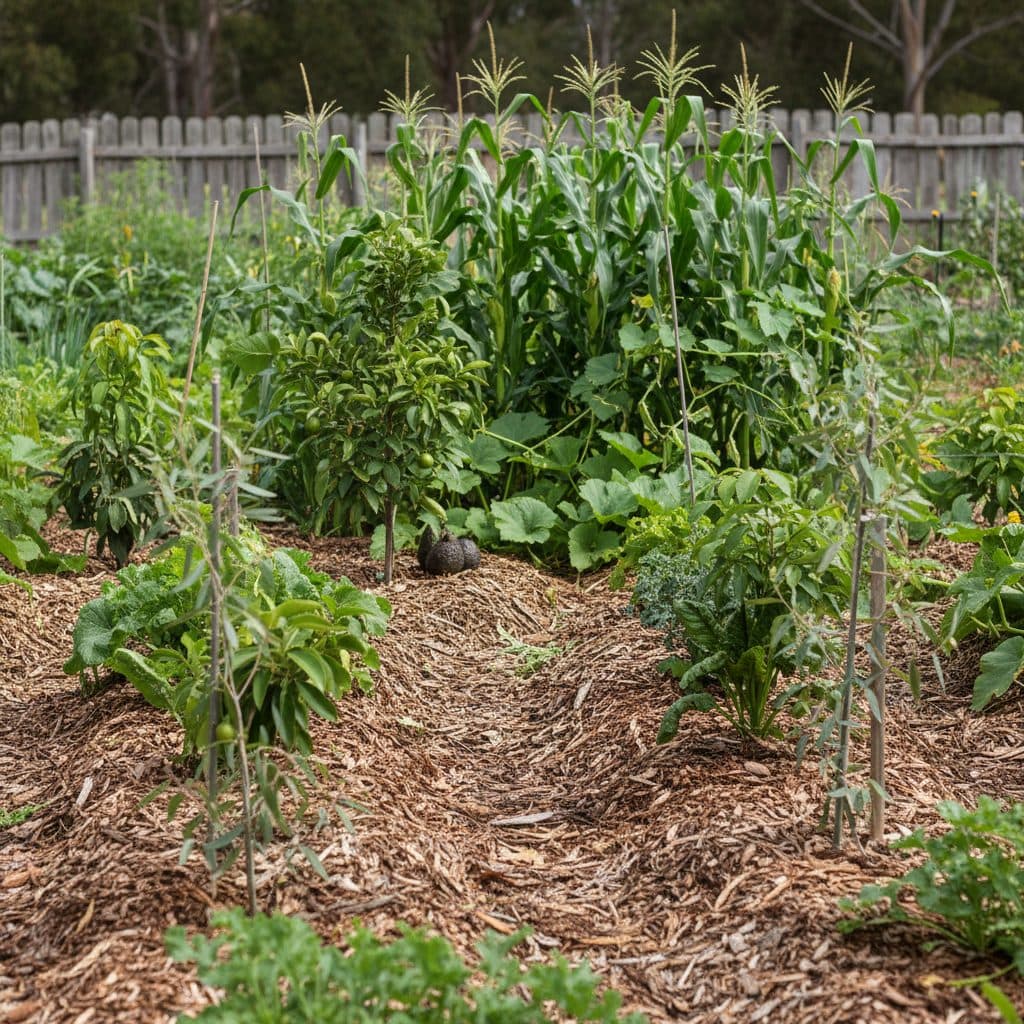
Key takeaways
- Master the two core pillars of syntropy: vertical light stratification and temporal ecological succession.
- Plant densely in structured linear rows, combining fast biomass trees with cash crops and perennial fruit trees.
- Manage the Placenta phase during early years by harvesting quick annual vegetables while canopy trees establish.
- Prune biomass trees heavily during active growth pulses to stimulate root growth and deposit thick mulch.
- Cut bought-in fertiliser sharply by fixing nitrogen with legumes and recycling nutrients on site through continuous chop-and-drop — while soil testing for the minerals (phosphorus, potassium, calcium) that biomass cycling can only move around, not create.
Quick answer: Syntropic farming for beginners is a process-based agroforestry method developed by Ernst Götsch that mimics natural forest succession and stratification. By planting high-density linear polycultures of biomass trees, fruit crops, and vegetables, growers accelerate soil fertility and produce continuous food without external fertilizers or tilling.
Modern agriculture often views nature as a competitor to be controlled with synthetic fertilizers, herbicides, and mechanical tillage. In contrast, syntropic agriculture, pioneered by Swiss-Brazilian farmer and researcher Ernst Götsch, works by aligning human production with the natural evolutionary tendency of ecosystems to move from simple, low-energy states toward complex, high-biomass forests (the idea Götsch calls syntropy, his framing of that tendency rather than a law of thermodynamics).
For small-scale growers, homesteaders, and market gardeners, practicing syntropic farming for beginners offers a practical framework for creating abundant, drought-resilient food production systems. Unlike conventional orchards or isolated garden beds, a syntropic system stacks annual vegetables, berry shrubs, dynamic accumulator trees, and timber species into dense, mutually supportive linear guilds.
By understanding the twin concepts of stratification in space and succession over time, you can design a high-yielding syntropic planting plan for small acreages or backyard plots in temperate and subtropical climates alike.
The two core pillars: stratification and succession
To design a successful syntropic system, you must master how plants interact in three dimensions (vertical space) and four dimensions (time).
+-------------------------------------------------------------------------------+
|                      THE TWO PILLARS OF SYNTROPIC DESIGN                      |
|                                                                               |
|   1. STRATIFICATION (Vertical Canopy Layering):                               |
|      --> Emergent (100% Sun)    : Poplar, Willow, Birch, Alder                |
|      --> High Stratum (80% Sun) : Apples, Pears, Peaches, Corn, Sunflowers    |
|      --> Medium Stratum (60%)   : Citrus, Figs, Pomegranates, Tomatoes, Beans |
|      --> Low Stratum (40% Sun)  : Berries, Ginger (warm), Sweet Potatoes     |
|      --> Ground Cover (20% Sun) : Fungi, Leaf Mould, Creeping Herbs           |
|                                                                               |
|   2. SUCCESSION (Temporal Evolution over Years):                              |
|      --> Placenta I (0-6 Months): Radish, Lettuce, Quick Annuals              |
|      --> Placenta II (6-24 Mos) : Corn, Squash, Pigeon Pea (warm), Comfrey    |
|      --> Secondary (2-15 Years) : Berries, Bananas (warm), Medium Fruit Bushes|
|      --> Climax (15-100+ Years) : Hardwood Timber, Chestnuts, Mature Orchard  |
+-------------------------------------------------------------------------------+
For a comprehensive historical and ecological overview of Götsch's framework, explore our foundational guide on syntropic farming.
1. Stratification: sharing sunlight without competition
In a standard garden, planting trees close together results in stunted growth because identical species compete for the exact same light band. In syntropic agriculture, every plant in a guild belongs to a different light stratum.
An emergent tree (requiring 100% direct solar radiation) filters light for a high-stratum fruit tree (requiring 80% light), which in turn protects a medium-stratum bush (60% light) and a shade-loving low-stratum berry (40% light). Because shade-adapted leaves saturate at lower light levels, each stratum can work productively on the light it receives instead of every plant competing for the same band.
2. Succession: the changing of the guard
In nature, a clear-cut area does not transform into a mature oak forest overnight. It moves through distinct ecological phases.
In syntropy, we plant all successional stages simultaneously on day one: seeds of climax timber trees, bare-root fruit trees, biennial shrubs, and fast-growing annual vegetables. The annuals (the "Placenta") nurse the slow-growing perennials, providing ground shade and root exudates while delivering immediate harvests during year one.
Designing a small-scale syntropic planting plan
For a backyard garden or market farm, structure your syntropic system in alternating tree lines and vegetable beds aligned along a north-to-south orientation.
+-------------------------------------------------------------------------------+
|                       TYPICAL SYNTROPIC BED CROSS-SECTION                     |
|                                                                               |
|   [Tree / Biomass Line]       [3-Foot Veggie Strip]     [Tree / Biomass Line] |
|   Poplar / Willow (Emergent)  Tomatoes (High)           Birch / Poplar (Emerg.|
|   Apple / Peach (High)        Bush Beans (Medium)       Plum / Pear (High)    |
|   Pigeon Pea / Comfrey (Med)  Lettuce (Low)             Hazelnut (Medium)     |
|   Thick Woodchip / Leaf Mulch Deep Compost & Hay        Thick Woodchip Mulch  |
+-------------------------------------------------------------------------------+
+-------------------+-------------------+-------------------+-------------------------------------------+
| Stratum | Small-Scale Species| Growth Cycle | Primary System Function |
+-------------------+-------------------+-------------------+-------------------------------------------+
| Emergent Layer | Poplar / Willow / | Perennial / Fast | Heavy biomass, rapid carbon generation, |
| (100% Light) | Birch / Alder | Coppice (1-2 yrs) | upper light filtration for fruit trees |
| High Layer | Apple, Pear, Peach| Perennial Fruit | Primary fruit harvest; structured pruning |
| (80% Light) | or Corn / Sunflower| (2 to 30+ years) | for maximum fruiting spur health |
| Medium Layer | Hazelnut, Elderberry| Multi-stem Shrub | Understorey yield; EFB-resistant hazel cvs|
| (60% Light) | or Bush Tomatoes | (1 to 10 years) | in East; dynamic mineral accumulation |
| Low Layer | Currants, Gooseb.,| Herbaceous / Bush | Low-light fruit; check state Ribes bans; |
| (40% Light) | Strawberries | (1 to 5 years) | living soil moisture barrier at ground |
+-------------------+-------------------+-------------------+-------------------------------------------+Black locust (Robinia pseudoacacia) is invasive outside its native Appalachian/Ozark range and is prohibited or restricted in several states (Massachusetts and Wisconsin among them). Cutting it back stimulates aggressive root suckering. Check your state's regulated plant list first, and prefer a non-suckering biomass species where it is a problem. East of the Rockies, plant only Eastern-filbert-blight-resistant hazelnut cultivars or American hybrids. Check your state before planting Ribes — currants and gooseberries remain banned or permit-only in several states because they host white pine blister rust. Tropical species (Cassava, coffee, bananas, pigeon pea) are field-viable only in warm zones (9b-10+).
To compare species selections across varied climate zones, study our reference on syntropic chop and drop species by zone.
Step-by-step implementation: day one planting
Follow this sequence to establish your first syntropic row:
- Mark Linear Contours: Lay out a 3-foot (1 m) wide tree line bed. Decompact the soil with a broadfork, but avoid inverted rototilling.
- Plant the Perennial Core: Dig planting holes along the center line. Space primary fruit trees 10 to 12 feet (3 to 3.6 m) apart. In the gaps between fruit trees, plant fast-growing biomass coppice trees (such as hybrid poplar, willow, or alder) every 3 feet (1 m).
- Sow the Placenta Polyculture: In the open soil around the tree root zones, sow a dense seed blend of corn, sunflowers, climbing beans, squash, and radishes.
- Blanket with Coarse Organic Carbon: Cover the entire bed surface with a 4- to 6-inch (10 to 15 cm) layer of freshly chipped branches, shredded leaves, and coarse woodchips. The wood must touch the soil to initiate fungal mycelial colonization.
To learn how multi-layered perennial systems compare to traditional permaculture forest gardens, read what is a food forest.
The power of pruning: pulsing the system
Pruning in syntropic agriculture is not an occasional aesthetic chore; it is the primary engine that drives soil fertility and system health.
+-------------------------------------------------------------------------------+
|                       THE SYNTROPIC PRUNING FEEDBACK LOOP                     |
|                                                                               |
|   1. Heavy Canopy Pruning  --> Drastic reduction in above-ground leaf area    |
|   2. Root Shedding         --> Fine roots slough off, creating soil pores     |
|   3. Organic Matter Pulse  --> Decaying root mass enriches the rhizosphere    |
|   4. Ground Biomass Layer  --> Chopped branches feed saprophytic wood fungi   |
|   5. Rejuvenation Pulse    --> Neighbouring fruit trees surge with new vigour |
+-------------------------------------------------------------------------------+
When you prune a biomass tree heavily during its active growth flush (early summer), the plant sheds a portion of its fine root network. These sloughed roots decay underground, creating thousands of microscopic aeration channels and depositing organic carbon directly into the rhizosphere.
Simultaneously, dropping the woody prunings onto the soil surface feeds saprotrophic wood-rotting fungi, which break down lignin and recycle phosphorus and trace minerals for your fruit trees.
For practical guidelines on handling fast-growing leguminous trees and calculating biomass yields, see our notes on pruning leucaena for biomass — noting that leucaena is a listed invasive in Hawaii, Florida and other warm regions and should not be planted there.
Common beginner mistakes to avoid
- Fear of Dense Planting: Beginners often plant trees too far apart, leaving exposed soil between trunks. In syntropy, dense planting creates the microclimate required for rapid root collaboration.
- Neglecting the Wood Layer: Straw and grass clippings alone are insufficient; you must incorporate woody branches (ramial chipped wood) to establish long-term fungal dominance in the soil.
- Delaying the First Prune: Never let biomass trees outgrow and shade out your primary fruit trees. Prune biomass pioneers early and often to direct the system's energy toward your target crops.