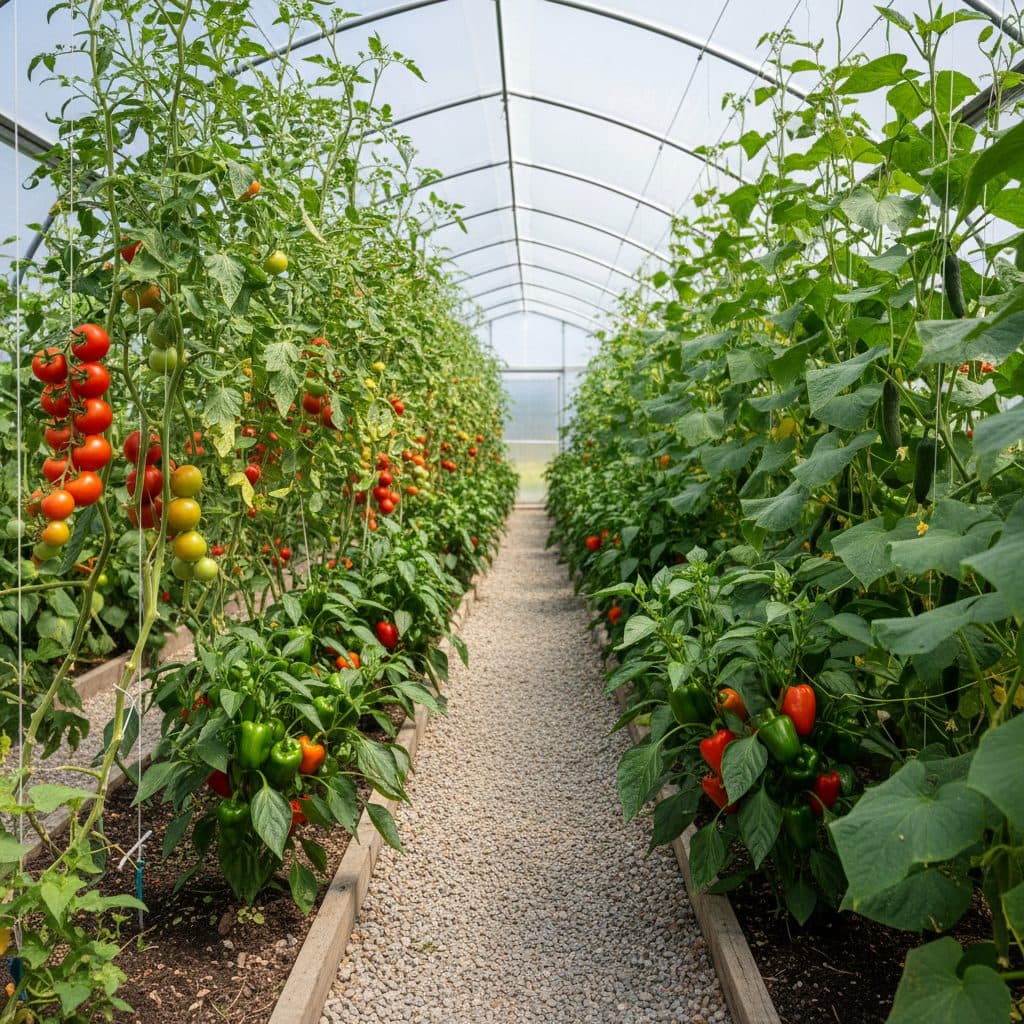
Key takeaways
- Maximise polytunnel productivity with a continuous 12-month succession across spring, summer, and winter.
- Grow tender summer crops like cordon tomatoes, aubergines, peppers, and cucumbers from May to September.
- Transition beds in October to cold-hardy winter salads such as winter purslane, mizuna, and corn salad.
- Design a practical layout with two 1-metre wide side growing beds and a central 70 cm wheelbarrow path.
- Maintain vigorous ventilation by opening doors and vents daily to prevent fungal grey mould.
Quick answer: What to grow in a polytunnel in the UK includes tender summer crops (tomatoes, chillies, cucumbers, and aubergines) followed by frost-hardy winter salads (mizuna, winter purslane, spinach, and overwintered broad beans). A polytunnel extends the British growing season to a full 12 months without artificial heating.
Erecting a polytunnel is one of the most transformative upgrades you can make to a UK garden or allotment plot. By modifying the surrounding microclimate, a polytunnel protects plants from cold easterly winds, buffers against late spring frosts, and captures precious solar warmth throughout dull, overcast British summers.
However, many gardeners underutilise their tunnels by treating them merely as temporary summer tomato shelters that sit abandoned and weed-choked from October to April. Knowing what to grow in a polytunnel throughout all four seasons allows you to harvest crisp, fresh produce every single week of the year without spending a penny on artificial heating.
By planning smooth seasonal successions, choosing space-saving cultivars, and maintaining healthy ventilation, you can turn a basic polyethylene hoop structure into a highly productive year-round food sanctuary.
The 12-month UK polytunnel growing calendar
To achieve continuous cropping, structure your polytunnel into two main seasonal shifts: the Summer Phase (May to October) and the Winter/Spring Phase (October to May).
+-------------------------------------------------------------------------------+
|                       12-MONTH UK POLYTUNNEL CALENDAR                         |
|                                                                               |
|   EARLY SPRING (March–April):  Early radishes, baby spinach, salad leaves     |
|   SUMMER (May–September):      Cordon tomatoes, chillies, cucumbers, aubergine|
|   AUTUMN (October–Nov):        Plant spring cabbage; sow winter salads/greens |
|   WINTER (Dec–February):       Harvest claytonia, mizuna, corn salad, spinach |
+-------------------------------------------------------------------------------+
+-------------------+-----------------------------------+-----------------------------------------------+
| Season | Primary Sowing & Planting Tasks | Key Crops Ready for Harvest |
+-------------------+-----------------------------------+-----------------------------------------------+
| Early Spring | Direct sow early salads/radishes; | Winter salads conclude; early radishes, |
| (March to April) | start summer seeds on staging | spring onions, baby spinach |
| Summer | Plant tomatoes, chillies, peppers,| Heavy harvests: tomatoes, cucumbers, early |
| (May to Sept) | cucumbers; plant sweet potato slip| carrots, french beans, aubergines, courgettes |
| Autumn | Clear spent vines; transplant | Sweet potatoes (lift by mid-Oct before frost);|
| (Oct to Nov) | spring cabbage; sow winter salads | late autumn peppers; Oriental brassica greens |
| Winter | Overwinter hardy salads and sow | Continuous pick-and-come-again winter leaves: |
| (Dec to Feb) | overwintering broad beans | winter purslane, mizuna, mibuna, lamb's lett. |
+-------------------+-----------------------------------+-----------------------------------------------+To coordinate seasonal bed transitions with the rest of your allotment, review our companion guide on crop rotation allotment.
Summer heat-lovers: tomatoes, chillies and cucumbers
From late spring through early autumn, the polytunnel becomes a high-heat engine for crops that struggle outdoors in Britain:
+-------------------+---------------------------+-------------------+-------------------------------------------+
| Crop              | Recommended UK Cultivar   | Spacing & Training| Key Cultivation Tip                       |
+-------------------+---------------------------+-------------------+-------------------------------------------+
| Cordon Tomato     | Sungold, Shirley, Sakura  | 45 cm apart; cord.| Pinch sideshoots weekly; string to hoops  |
| Greenhouse Cucumb.| Passandra, Carmen (All-F) | 50 cm apart; cord.| Train up string; all-female types need no |
|                   |                           |                   | male flower removal                       |
| Sweet & Hot Chili | Gypsy F1, Jalapeno        | 40 cm in beds/pots| High potassium feed once fruitlets set    |
| Aubergine         | Black Beauty, Moneymaker  | 45 cm in full sun | Mist flowers on dry days to aid fruit set |
| French Beans      | Cobra (Climbing)          | 20 cm along canes | Sow late Mar-Apr; pick from mid-June      |
+-------------------+---------------------------+-------------------+-------------------------------------------+
1. Cordon tomatoes
Cordon (indeterminate) tomatoes are the cornerstone of the summer tunnel. Train vines vertically up heavy jute twine tied to overhead crop bars. Prune out all lateral sideshoots weekly to focus plant energy on 6 to 8 heavy flower trusses.
For diagnostic troubleshooting on curling leaves or virus vectors in greenhouse nightshades, review our guide to tomato leaf curl diagnostics.
2. Cucumbers and aubergines
Choose all-female F1 hybrid cucumbers like Passandra. They produce sweet, seedless fruits without requiring pollination. Aubergines demand the hottest, sunniest position near the centre of the tunnel.
Winter polytunnel growing: the secret second season
When outdoor gardens freeze solid under snow and ice, a cold polytunnel maintains an active winter salad garden:
- Winter Purslane (Claytonia / Miner's Lettuce): One of the most reliable winter salads under cover. Survives hard freezes beneath plastic and produces juicy, succulent spade-shaped leaves packed with vitamin C from November to April.
- Oriental Brassicas (Mizuna, Mibuna, Pak Choi, Tatsoi): Fast-growing peppery greens that thrive in cool conditions. Harvest outer leaves continuously for stir-fries and fresh salads.
- Corn Salad (Lamb's Lettuce / Mache): Tender, nutty green rosettes that withstand sub-zero conditions without leaf damage.
- Land Cress and Rocket: Delivers robust peppery flavour all winter long.
During severe sub-zero cold snaps, drape a layer of horticultural fleece directly over your winter salad beds at night to provide an extra 2°C to 4°C of frost protection.
Space-efficient polytunnel layout ideas
How you configure your internal beds determines how much food you can harvest and how easily you can navigate with tools.
+-------------------------------------------------------------------------------+
|                       CLASSIC TWO-BED POLYTUNNEL LAYOUT                       |
|                                                                               |
|   +-----------------------------------------------------------------------+   |
|   |                  SIDE BED A (1.0 to 1.2 m wide)                       |   |
|   |   Tomatoes / Cucumbers trained vertically up overhead crop bars       |   |
|   +=======================================================================+   |
|   |         CENTRAL ACCESS PATHWAY (60 to 75 cm wide - Wheelbarrow)       |   |
|   +=======================================================================+   |
|   |                  SIDE BED B (1.0 to 1.2 m wide)                       |   |
|   |   Bush Peppers / Aubergines / Staging for spring seed trays           |   |
|   +-----------------------------------------------------------------------+   |
+-------------------------------------------------------------------------------+- Bed Width: Keep side beds between 1.0 m and 1.2 m wide so you can comfortably reach the back without stepping on the soil.
- Central Path: Maintain a 60 cm to 75 cm central pathway laid with gravel, woodchips, or flagstones. This width allows easy access for wheelbarrows and harvest crates.
- Overhead Crop Bars: Install steel crop support bars across the top hoops. These provide structural rigidity against winter winds and serve as anchor points for vertical plant support twines.
For precision spacing and thinning techniques for direct-sown tunnel crops, consult seedling care thinning spacing direct sowing.
Climate management: ventilation, humidity and shading
A polytunnel is an enclosed ecosystem that requires proactive management:
- Ventilation Is Paramount: High humidity plus stagnant air is the main driver of grey mould (Botrytis cinerea). Powdery mildew works differently — its spores need no leaf wetness and it is worst on plants under drought stress, so keep roots evenly moist as well as keeping the air moving. Open both end doors on all mild days to encourage gentle air exchange.
- Summer Shading: When temperatures exceed 30°C in July, drape 50% shade netting over the roof, or fit shade cloth inside. Shading washes are made for glass and are best avoided on polythene, where they are hard to remove.
- Watering Rhythms: In summer, water deeply at the base of plants in the early morning. In winter, water sparingly once every ten to fourteen days, ensuring foliage remains completely dry overnight to avoid fungal decay.