Key takeaways
- Couch grass spreads aggressively through underground creeping rhizomes that must be removed or starved of light to achieve permanent control.
- Use a sturdy garden fork rather than a spade or rotary tiller, which chop rhizomes into fragments that regenerate into new weeds.
- Smother dense infestations using heavy overlapping cardboard topped with 10 cm to 15 cm of organic mulch for at least 12 months, and up to 18 on dense infestations.
- Distinguish couch grass from benign lawn grasses by checking for clasping auricles at the leaf base and sharp, white rhizome tips.
- Avoid chemical weedkillers on edible plots as national approvals and environmental regulations change regularly.
- Drown excavated rhizomes in a covered bucket of water for six to eight weeks before composting to ensure all dormant buds are completely dead.
Quick answer: To get rid of couch grass organically, systematically fork through the soil to extract the white, wiry underground rhizomes without breaking them, or cover the infested area with thick cardboard and organic mulch for 12 to 18 months to starve the root system. Rotary tilling must be avoided because every severed root node can produce a new plant.
Couch grass (Elymus repens, formerly Agropyron repens) is one of the most persistent perennial weeds facing UK allotment holders and garden enthusiasts. Known colloquially as twitch, scutch, or quitch, this vigorous grass colonises neglected borders, vegetable patches, and compost heaps with remarkable speed.
Its resilience stems from an extensive network of underground rhizomes that store carbohydrate reserves and produce sharp, penetrating shoots. While tackling couch grass requires persistence, understanding its growth habits allows you to eradicate it systematically using cultural and physical methods without relying on chemical sprays.
Identifying couch grass versus other grasses
Before beginning removal, confirm that the weed is indeed couch grass. Identifying key botanical features ensures you apply the correct control strategy and do not confuse it with clumping lawn grasses.
+-------------------------------------------------------------+
|                COUCH GRASS BOTANICAL FEATURES               |
|                                                             |
|   Leaf Blade: Dull green, slightly ribbed, rough on top     |
|         \                                                   |
|          ___ Auricles: Small, claw-like projections        |
|               clasping the stem at the leaf base            |
|                                                             |
|   Soil Surface ==========================================   |
|                                                             |
|   Rhizome: Sharp, white, wiry creeping root with distinct   |
|            nodes every 2 cm to 5 cm producing vertical buds |
+-------------------------------------------------------------+- Underground rhizomes: Couch grass produces tough, white, creeping rhizomes with needle-sharp tips that easily pierce through dense clay, potato tubers, and lightweight ground fabrics. Each node along the rhizome bears a dormant bud capable of generating a fresh shoot.
- Leaf stem junction (Auricles): Where the leaf blade meets the sheath, couch grass displays two small, claw-like appendages (auricles) that wrap around the stem. Creeping bent and annual meadow grass have no auricles, so this separates couch from both — but perennial ryegrass has auricles too, so confirm with the decisive character: the white, sharp-tipped creeping rhizome.
- Flower spikes: In mid-to-late summer, couch grass produces unbranched flower spikes resembling slender ears of wheat, with flat spikelets arranged alternately along the central stem.
Manual excavation: forking out couch grass roots
Manual removal is the fastest way to clear couch grass from active growing beds and borders. However, technique is critical to avoid multiplying the problem.
1. Choose the right tool
Never use a rotary tiller, spade, or mechanical strimmer in soil infested with couch grass. Spades and blades slice the brittle rhizomes into short segments, each containing one or two nodes. When watered, every single fragment sprouts into an independent plant, turning a small patch into a dense carpet.
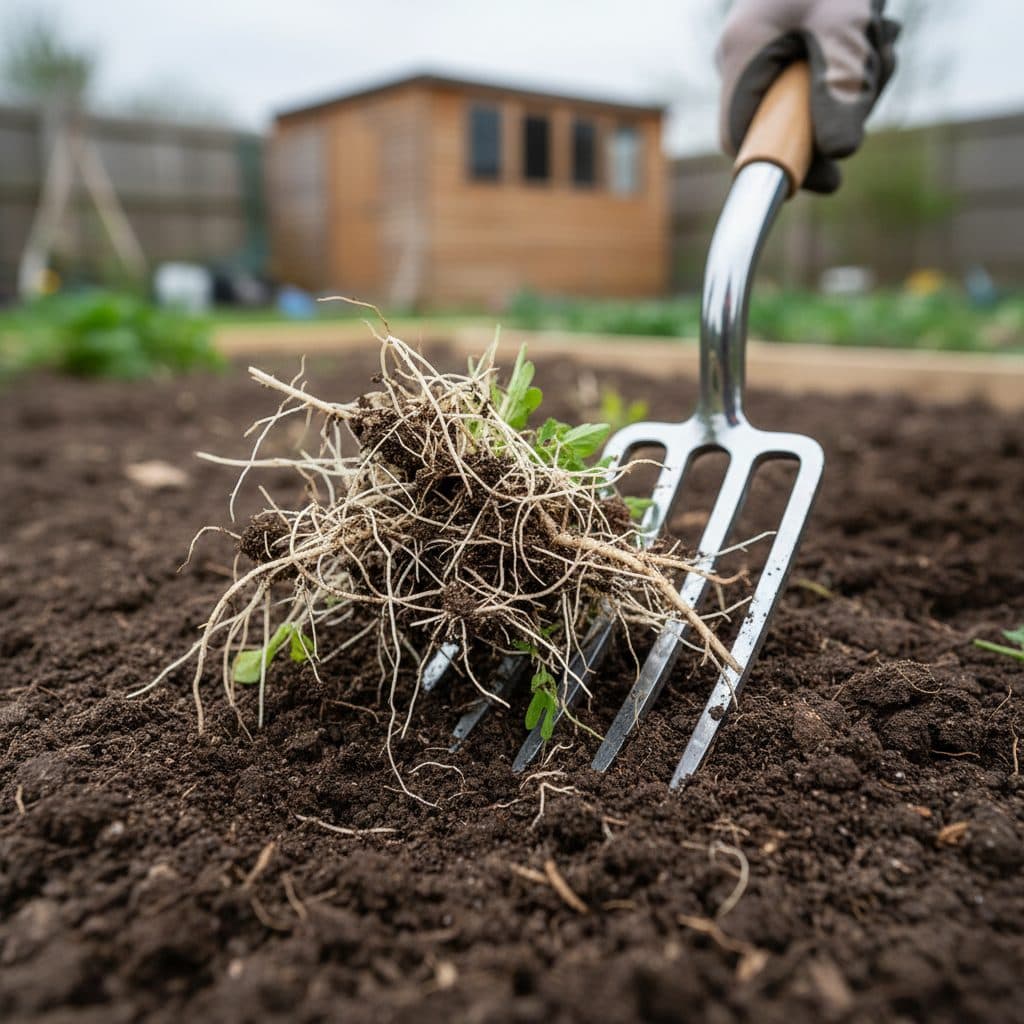
Use a flat-tined garden fork or border fork. Forks loosen the soil around the rhizomes, allowing you to tease out entire root cords intact without snapping them.
2. Work backwards across the bed
Choose a dry day when the soil is workable but not bone-dry. Insert the fork deeply behind the root mass, lever the soil upward, and gently shake loose earth away from the roots. Grasp the base of the stems and trace the white rhizomes through the crumbly soil, pulling steadily to extract the full running length.
Follow our advice on maintaining organic gardening soil to keep the soil loose and friable, which makes future root extraction significantly easier.
3. Safely dispose of excavated roots
Never throw fresh couch grass rhizomes onto an active compost heap. The moisture and warmth inside domestic heaps often encourage the buds to sprout, which will spread the weed across your entire plot when you apply the finished compost.
Instead, place the excavated roots into a plastic bucket filled with water, fit a lid, and let them ferment for six to eight weeks. Once the rhizomes have turned into dark, foul-smelling liquid mush, all viable buds are dead. The nutrient-rich liquid can be diluted as a plant feed, and the decomposed residue can safely be added to your compost pile. Alternatively, lay the roots out on a concrete path or corrugated iron sheet under hot summer sun until they are completely desiccated and brittle before composting.
Smothering couch grass with light-deprivation mulch
For large allotment plots, overgrown borders, or areas where manual forking is too labour-intensive, sheet mulching provides a highly effective, low-effort organic solution. This method starves the rhizomes of sunlight until their stored energy reserves are entirely exhausted.
- Mow or scythe the area: Cut down top growth as close to the soil line as possible. Leave the cut foliage in place.
- Lay heavy cardboard: Cover the ground with clean, unprinted, corrugated cardboard. Ensure every seam overlaps by at least 15 cm to 20 cm, as couch grass shoots will actively seek out and push through narrow gaps.
- Apply deep organic matter: Spread a layer of 10 cm to 15 cm of well-rotted manure, woodchips, or garden compost over the cardboard. The weight pins the cardboard flat, and the organic material keeps the cardboard moist, promoting microbial activity. Learn more about effective coverage in our guide to sheet mulching for moisture and soil building.
- Maintain coverage for 12 to 18 months: Couch grass rhizomes can survive for over a year on stored starches. By the following spring the cardboard will have largely rotted down and the bulk of the couch will be dead, but expect survivors along the edges and wherever the seams gaped — check the whole area and fork out any live rhizome before planting.
Control Method | Time Required | Labour Intensity | Best Suited For |
|---|---|---|---|
Manual Forking | 1–2 days per bed | High | Active vegetable beds, mixed flower borders |
Cardboard Sheet Mulch | 12–18 months | Low | New allotment plots, large vacant areas |
Competitive Cover Cropping | 1 full season | Moderate | Fallow beds, transition zones |
Regular Hoeing | Ongoing (weekly) | Moderate | Seedling control, emerging green tips |
Competitive cropping and no-dig barrier strategies
Once you have cleared the majority of couch grass, preventing re-invasion from neighbouring paths or neglected allotment plots is vital. Couch grass roots routinely migrate horizontally across boundary lines.
Installing vertical root barriers
Bury a vertical physical barrier of rigid plastic lawn edging, slate tiles, or metal sheeting 20 cm to 30 cm deep along the perimeter of your vegetable beds. This stops lateral rhizomes from creeping beneath timber edging and penetrating your growing area.
Growing competitive crops
Dense, vigorous crops help suppress weakened couch grass regrowth. Growing maincrop potatoes creates a thick canopy of broad leaves that shades the ground rapidly. As you practice earthing up during the season, you repeatedly disturb any surviving grass shoots while harvesting clean tubers. You can learn more about general crop setup in our guide on how to grow potatoes.
Dense green manures like winter rye mixed with vetch also outcompete stray grass weeds while fixing nitrogen and improving soil structure. Review our detailed overview of soil amendments demystified for insights on using organic covers to strengthen soil vitality.
Why chemical weedkillers are problematic
Some gardeners turn to chemical systemic herbicides when facing severe couch grass infestations. However, on domestic vegetable plots and allotments, chemical treatments carry significant drawbacks. UK pesticide regulations change frequently, and active ingredients approved in past years are periodically restricted or withdrawn to protect soil organisms and watercourses.
Furthermore, non-selective systemic weedkillers can drift onto neighbouring edible crops, damage perennial fruit bushes, and leave residues in the soil profile. Relying on thorough physical extraction and sheet mulching builds long-term soil health and ensures a truly organic harvest without chemical dependency. For general comparisons on household weed remedies, read our factual breakdown on vinegar weed killer facts.
Long-term maintenance and eradication timeline
Eradicating couch grass is a process of systematic reduction rather than an overnight fix. By establishing a routine, you can keep your plot completely clear of the weed:
- Year 1 (Initial Clearance): Carry out thorough manual forking of primary beds or establish 12-month cardboard sheet mulching over neglected areas.
- Year 2 (Vigilance & Spot-Weeding): As stray shoots emerge from deep surviving root pieces, immediately trace them down with a hand fork. Never pull from the surface, which snaps the stem from the root node.
- Year 3 Onwards (Prevention): Maintain thick organic surface mulches, inspect border edges monthly, and keep perimeter paths mown to prevent seed set.
With consistent physical control, soil aeration, and light deprivation, couch grass can be reduced to the occasional stray shoot and kept out of your growing beds.