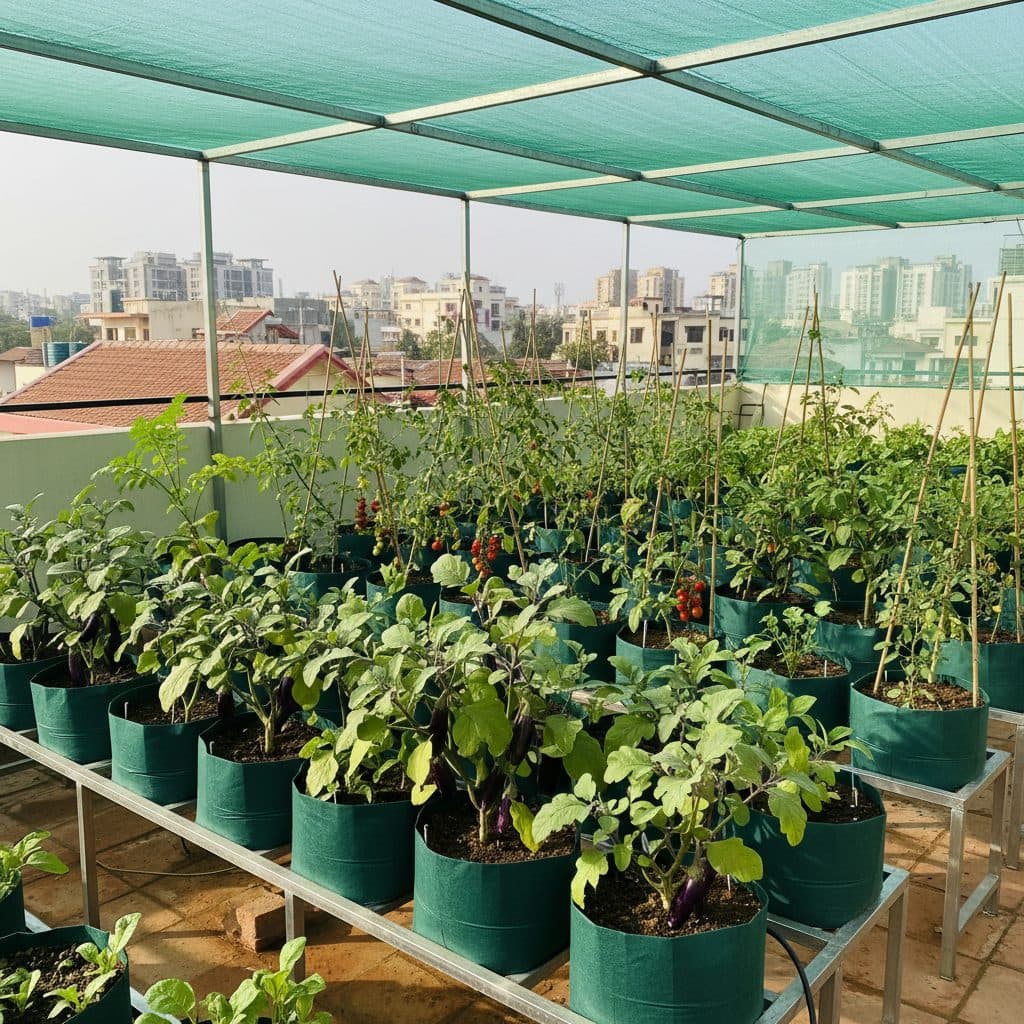
Key takeaways
- Pune's Deccan plateau climate (elevation 560 m) offers a favorable year-round growing environment across kharif, rabi, and zaid seasons.
- Protect roof slabs from moisture damage by placing grow bags on elevated metal stands or drainage cell mats rather than directly on concrete.
- Lightweight potting mix consisting of cocopeat, compost or vermicompost, red soil, and neem khali prevents excessive structural roof load.
- Rabi season (October to February) is Pune's most productive window for leafy greens, brassicas, carrots, and root vegetables.
- Peak summer (March to May) demands fifty percent UV-stabilized green shade netting and daily morning watering to combat summer heat reaching the low 40s.
- Monsoon rains require free-draining media, clear drainage eyelets and containers raised off the slab — root rot is prevented by drainage, not by spraying.
Quick answer: Setting up a terrace garden in Pune takes advantage of the city's moderate Deccan plateau climate to produce fresh organic vegetables across three distinct growing seasons. Success relies on protecting roof slab waterproofing with elevated stands, blending lightweight cocopeat and vermicompost mixes, using fifty percent shade netting during summer, and timing plantings for kharif and rabi seasons.
Urban rooftop gardening has become a major lifestyle movement across Pune. From standalone bungalows in Aundh and Kothrud to apartment terraces in Kharadi and Baner, growing food on concrete roofs connects urban residents with fresh, chemical-free produce.
Pune enjoys a distinct climatic advantage over coastal metros. Situated on the Deccan plateau at an elevation of 560 meters, the city experiences lower ambient humidity than Mumbai and cooler winter nights. However, rooftop growing introduces unique physical challenges: intense radiant heat from concrete slabs, heavy monsoon cloudbursts, fierce pre-monsoon winds, and pest pressure from urban pigeons.
By understanding structural load distribution, soil-less media blending, seasonal cropping calendars, and organic pest protection, you can build a productive terrace garden in Pune.
Structural terrace preparation and waterproofing safety
Before bringing heavy soil and water onto a concrete roof slab, evaluate the structural capacity and drainage of your building.
+-------------------------------------------------------------+
|               TERRACE LAYER SAFETY STRUCTURE                |
+-------------------------------------------------------------+
| [Vegetable Plant in UV-Treated HDPE Grow Bag]               |
|                           |                                 |
| [Potting Mix: 40% Cocopeat + 30% Vermicompost + 30% Soil]   |
|                           |                                 |
| [Elevated Metal Stand or Recycled Drainage Tile (5-10 cm)]  |
|                           |                                 |
| [Air Gap for Airflow & Free Water Runoff]                   |
|                           |                                 |
| [Slab Surface with Bituminous or Polyurethane Waterproofing]|
+-------------------------------------------------------------+
Waterproofing and drainage pathways
Water seepage into the residential ceiling below is the most common fear among prospective terrace growers. Follow these practical precautions:
- Inspect existing slab waterproofing: Ensure the rooftop has intact bituminous coating, polyurethane membrane, or traditional China mosaic chips. Repair any cracks before setting up pots.
- Never place grow bags directly on concrete: Damp grow bag bases trap moisture against the concrete, promoting moss and micro-cracks. Use elevated metal stands, plastic pot risers, or interlocking drainage cell mats that maintain a 5 to 10 cm air gap beneath containers.
- Keep rainwater drain channels clear: Ensure the terrace slope directs excess runoff freely toward rooftop drainage spouts without pooling around containers.
Weight load management on urban roofs
Wet garden soil is exceptionally heavy, weighing up to 1,600 to 1,800 kg per cubic metre. To maintain structural safety on residential slabs:
- Keep the largest and heaviest containers close to the perimeter, over the columns and edge beams, rather than out in the middle of a broad slab span. A 100 litre drum of wet mix weighs 150 kg or more at the 1,600-1,800 kg per cubic metre figure above, and a dozen of them is a real load — before you commit to a heavy layout, have a structural engineer confirm the live load your slab was designed for, and get your housing society's written permission. Do not treat the parapet as load-bearing; it usually sits on the slab and carries nothing.
- Reserve the center of broad slab spans for lightweight grow bags, vertical trellises, and shallow seedling trays.
- Adhere to core principles of rooftop and patio container gardening to calculate container spacing and avoid concentrated structural loads.
Potting mix formulation for Pune terraces
Standard garden red soil (laal maati) from local nurseries becomes dense and waterlogged in containers, especially during monsoon downpours. A custom, lightweight potting blend provides root aeration, nutrient retention, and structural safety.
       Ideal Pune Terrace Potting Mix Composition

 +------------------+------------------+
 |   COCOPEAT       |   VERMICOMPOST   |
 |   40% By Volume  |   30% By Volume  |
 |   (Moisture/Air) |   (Nutrient Hub) |
 +------------------+------------------+
 |   RED SOIL       |   NEEM CAKE      |
 |   30% By Volume  |   Handful/Bag    |
 |   (Mineral Body) |   (Nematodes)    |
 +------------------+------------------+
The 40-30-30 soil recipe
Blend the following components thoroughly before filling containers:
- 40% De-salted cocopeat: Expands when hydrated to provide lightweight structure and hold moisture during dry summer heatwaves.
- 30% Vermicompost or aged cow dung manure (gobar khaad): Delivers essential nitrogen, phosphorus, potassium, and beneficial microbes.
- 30% Sifted red garden soil: Supplies trace minerals and clay-silt particles that anchor root systems.
- Neem cake (neem khali), a handful (50 to 100 g) per 30 cm bag: a slow-release nitrogen source with useful activity against root-knot nematodes. Mix it in before planting.
Selecting durable containers
- UV-stabilized HDPE grow bags: Opt for 200 to 350 GSM green or white HDPE grow bags. Sizes of 24x24 cm suit leafy greens, 30x30 cm work well for brinjal, tomatoes, and chillies, while 40x40 cm bags support vining gourds.
- Terracotta pots: Provide natural evaporative cooling for root systems in summer, but add considerable weight. Use sparingly on older buildings.
Seasonal planting calendar for Pune
Pune experiences three defined agricultural seasons: kharif (monsoon), rabi (winter), and zaid (summer). Timing your seed sowing to these seasonal shifts ensures high harvest yields.
Season | Months | Climate Characteristic | Best Terrace Crops |
|---|---|---|---|
Kharif | June to September | Heavy rain, high humidity, 24–30°C | Brinjal, bhindi, ridge gourd, bottle gourd, chillies, tomatoes, sweet corn |
Rabi | October to February | Mild days, cool nights (12–18°C), low humidity | Palak, methi, coriander, carrots, radish, cauliflower, cabbage, peas, beetroot |
Zaid | March to May | High 30s to low 40s °C, high evaporation | Amaranth (chaulai), mint (pudina), cucumber, bitter gourd, cluster beans (gawar) |
Kharif season (monsoon) management
The southwest monsoon reaches Pune in early June.
- Sow seeds of climbing cucurbits (ridge gourd, bottle gourd, sponge gourd) on bamboo mandap trellises; explore vertical vining crops in pots for space-saving trellis setups.
- Ensure all grow bags have side drainage holes clear of debris.
- Apply a preventative spray of cold-pressed neem oil (5 ml per litre of water with 2 ml liquid soap) every ten days to keep sucking pests in check; manage leaf spot by spacing pots for airflow and removing affected leaves, not by spraying neem.
Rabi season (winter) bounty
October through February represents the peak growing window in Pune. Clear sunny days and cool nights allow temperate vegetables to thrive.
- Direct-sow leafy greens (palak, methi, coriander) every two weeks for continuous kitchen harvests.
- Transplant seedlings of cabbage, cauliflower, knol-khol, and broccoli into 30 cm containers.
- Sow root crops such as round red radishes, carrots, and beetroots; consulting growing carrots and root vegetables in containers ensures deep root formation without stunted tips.
Zaid season (summer) heat protection
From mid-March to May, daytime temperatures in Pune regularly climb into the high 30s, with hot spells reaching the low 40s. Concrete rooftops absorb heat throughout the day, baking container root systems.
- Erect green shade netting: Install fifty percent UV-stabilized green agro-netting 2.5 to 3 meters above the terrace floor. This takes the worst of the radiant load off both the plants and the slab, without cutting light enough to make growth leggy.
- Mulch grow bag surfaces: Cover exposed soil in every container with a 3 to 5 cm layer of dried sugarcane bagasse, dried grass clippings, or crushed dry leaves to slow surface evaporation. Reviewing mulching vegetables and container crops helps maintain stable soil moisture.
- Watering schedule: Water thoroughly before 8:00 AM and provide a secondary light drink after 6:00 PM on hot days. Check practical guidelines in container gardens summer survival to prevent heat-induced blossom drop.
Organic pest and urban pigeon management
Urban terrace gardens face distinctive pest pressures from insects and urban wildlife.
Managing blue rock pigeons (kabootar)
Pigeons are common in Pune residential societies, stripping tender seedlings of methi, palak, and brassicas within minutes.
- Nylon bird netting: Enclose growing zones with UV-stabilized 25 mm diamond mesh nylon pigeon netting. Secure the net along bamboo frames or balcony railings to create a physical barrier.
- Wire cloches: Place inverted wire mesh baskets over newly germinated seedlings until plants develop mature, fibrous leaves.
Controlling common garden insects
- Aphids and whiteflies: Spray an emulsion of neem oil and mild liquid soap directly on leaf undersides during evening hours.
- Leaf-eating caterpillars: Handpick caterpillars during morning inspections, or apply biological Bacillus thuringiensis (Bt) formulations; review organic caterpillar and beetle control for non-toxic pest suppression.
- Mealybugs: Wipe infested stems with a cotton swab dipped in rubbing alcohol, followed by a neem oil soil drench or a neem cake top-dressing, repeated at 7 to 10 day intervals — the waxy coating protects adults and eggs hatch in waves, so a single treatment will not clear an infestation.
By respecting structural safety, blending aerated soil-less media, and adapting planting cycles to Pune's Deccan seasons, you can enjoy abundant organic harvests right outside your doorway. At agripure, proven organic growing techniques help city gardeners get steady harvests off a concrete roof.