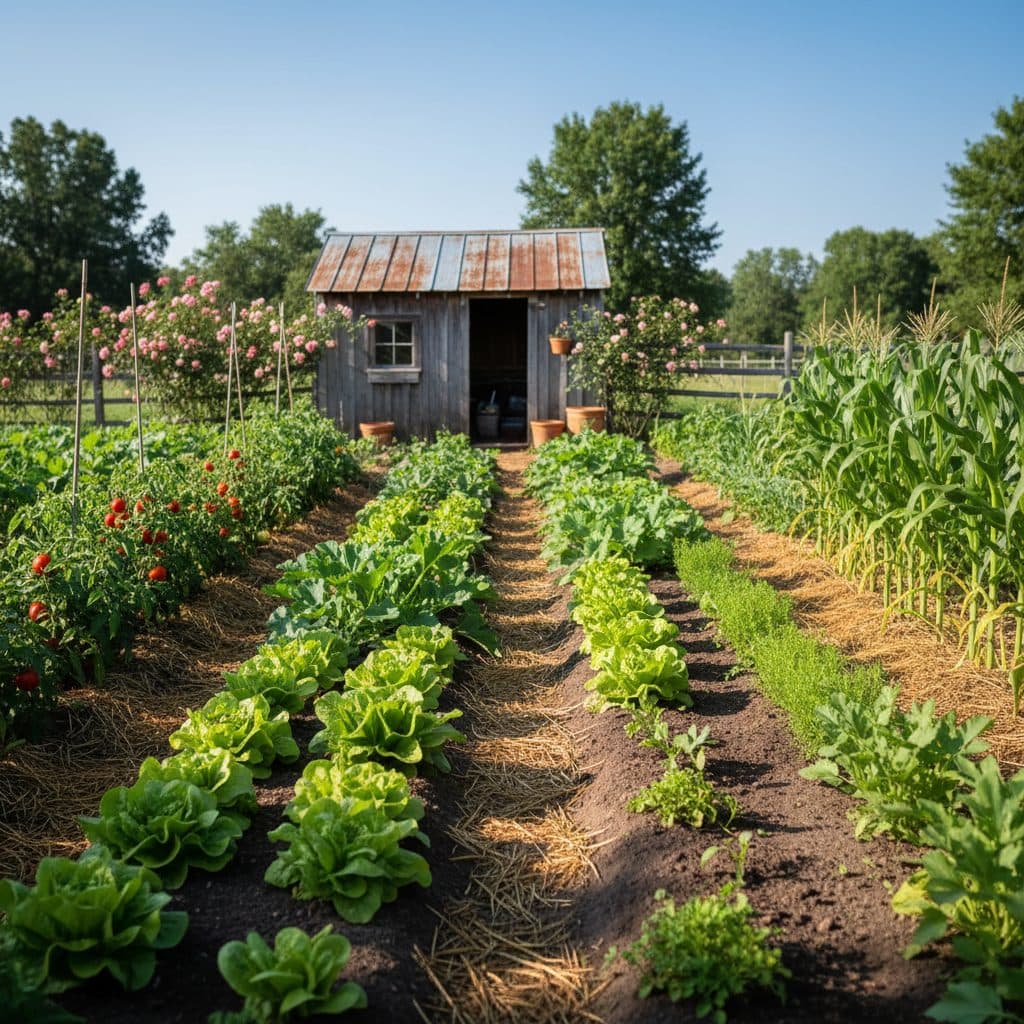
Key takeaways
- Open-pollinated (OP) seeds offer genetic diversity, allowing plants to adapt to local conditions over generations and enabling gardeners to save seeds that breed true.
- Hybrid (F1) seeds provide specific traits like increased vigor, uniformity, and disease resistance, often leading to higher yields in a single season, but their seeds do not reliably reproduce parental traits.
- Crop rotation, a practice of changing crop families in a specific area over three to four years, significantly reduces pest and disease pressure for both OP and hybrid varieties.
- Succession planting ensures a continuous harvest by staggering plantings of the same crop, maximizing garden productivity throughout the growing season, especially beneficial for quick-maturing varieties.
- Choosing between OP and hybrid depends on your goals: seed saving and adaptability favor OP, while specific traits and high initial yields often point to hybrids.
- Integrating seed choices with a USDA-zone specific planting calendar and practices like cover cropping can build soil health and improve long-term garden productivity.
Quick answer: Choosing between open-pollinated (OP) and hybrid (F1) seeds depends on your goals: OP seeds offer genetic diversity for adaptability and seed saving, while hybrid seeds provide specific traits like vigor and disease resistance for higher yields in a single season.
In the diverse climates of the United States, from the humid summers of USDA zone 8 in the Southeast to the shorter growing seasons of zone 4 in the Upper Midwest, growers face a fundamental decision: open-pollinated or hybrid seeds? This choice affects everything from your annual harvest to the long-term health of your soil and the resilience of your garden. For instance, a grower in central Pennsylvania, typically USDA zone 6b, might weigh the consistent yield of a hybrid tomato against the adaptability of an open-pollinated variety that can be saved and replanted year after year.
Understanding the distinctions between these seed types supports effective crop rotation, successful succession planting, and long-term garden productivity. Seed choices influence your planting calendar across different USDA zones and determine how crops handle varied weather patterns, from 100-degree Fahrenheit summer days to late spring frosts.
Understanding open-pollinated seeds for resilience and adaptability
Open-pollinated (OP) seeds are the foundation of genetic diversity in our food systems, representing varieties that have been stable for generations. These plants are pollinated by natural means, such as wind, insects, or birds, and when their seeds are saved and replanted, they will produce plants that are true to the parent type, provided they haven’t cross-pollinated with other varieties. This characteristic is particularly valuable for growers in regions like the high desert of Arizona, USDA zone 8, where specific drought-tolerant corn varieties have been adapted over centuries to thrive with minimal water, often less than 10 inches of annual rainfall. Saving these heirloom seeds allows gardeners to cultivate resilience.
The benefits of genetic diversity
The genetic diversity inherent in open-pollinated varieties means they often exhibit a wider range of traits, including varying resistance to pests and diseases, and adaptability to local soil and climate conditions. For example, a single variety of OP beans might show slight differences in plant height or pod size, but these variations can be advantageous in fluctuating weather patterns. In a typical USDA zone 5 garden in New England, a diverse planting of OP beans can better withstand a common bacterial blight outbreak, as some plants may possess natural resistance, ensuring at least a partial harvest under adverse conditions. This diversity is a key factor in long-term food security, as it allows plants to evolve with their environment, a process that can be observed over just five to ten generations of careful seed saving.
- Allows for seed saving that breeds true to type.
- Promotes genetic diversity and adaptability to local climates.
- Common among heirloom varieties that preserve historical traits.
- Supports long-term food independence for growers.
- Can develop increased resistance to regional pests and diseases over time.
Hybrid seeds and their role in modern production
Hybrid, or F1, seeds are the result of controlled crosses between two distinct parent lines, chosen for specific desirable traits. These first-generation hybrids often exhibit what’s known as ‘hybrid vigor,’ leading to plants that are more uniform, grow faster, and produce higher yields than either parent. For commercial growers in California’s Central Valley, a major agricultural region, hybrid tomatoes might yield 30-50 tons per acre, significantly more than many open-pollinated varieties, making them a preferred choice for large-scale production. However, if you save seeds from a hybrid plant, the offspring in the F2 generation will not reliably reproduce the parent’s traits, often reverting to characteristics of one of the grandparents or exhibiting unpredictable variations.
Maximizing yield and uniformity
The primary appeal of hybrid seeds lies in their predictable performance and specific trait expression. Breeders can select for resistance to common diseases, such as powdery mildew in squash or fusarium wilt in melons, which can devastate crops in humid climates like those found in USDA zone 7 in the Mid-Atlantic. This bred-in resistance can reduce the need for chemical interventions, contributing to more efficient resource use. Furthermore, the uniformity of hybrid crops simplifies harvesting and processing, as plants mature at similar rates and produce fruits of consistent size and shape, which is critical for marketability. For example, a hybrid sweet corn variety might mature in 75 days across 95% of the crop, allowing for a single, efficient harvest.
- Offers hybrid vigor, leading to increased growth and yield.
- Provides uniformity in plant size, maturity, and fruit characteristics.
- Often bred for specific disease or pest resistance.
- Seeds saved from hybrids do not breed true to type.
- Requires purchasing new seeds each growing season.
Strategic choices for your garden and farm
Deciding between open-pollinated and hybrid seeds depends on specific goals and resources. If your primary aim is to save seeds, adapt crops to a local microclimate, or preserve heritage varieties, open-pollinated types are suitable. For example, a small farm in rural Vermont, USDA zone 4, might save seeds from an early heirloom tomato such as ‘Stupice’, which reliably ripens in a short growing season. Conversely, where maximizing yield, achieving market uniformity, or managing specific diseases is the priority, hybrids provide practical advantages. A large-scale organic vegetable operation in central California, USDA zone 9, might plant hybrid bell peppers for consistent fruit size and resistance to pepper mild mottle virus, maintaining crop yield with losses often under 5% from disease.
Balancing adaptability and productivity
Many growers find a balanced approach to be most effective, incorporating both seed types into their planting plans. You might choose open-pollinated varieties for staple crops like beans or peas, which are easy to save and contribute to long-term self-sufficiency, while opting for hybrid cucumbers or zucchini for their disease resistance and prolific production during the peak summer months. For a market gardener in USDA zone 7, growing both an open-pollinated ‘Cherokee Purple’ tomato for its unique flavor and a hybrid ‘Celebrity’ tomato for its reliability and high yield can diversify offerings and mitigate risks. This strategy leans mostly on OP varieties for seed saving, complemented by a smaller share of hybrid plantings for specific market demands, offering a blend of resilience and productivity. Consider using cover crops to improve soil health for both types of plants.
- Choose OP for seed saving, genetic diversity, and climate adaptation.
- Select hybrids for high yields, uniformity, and specific disease resistance.
- Consider a mix of both types to balance resilience and productivity.
- Evaluate crop-specific needs and market demands for each seed type.
- Factor in the cost of new hybrid seeds versus saved OP seeds.
Integrating seed choices with crop rotation and succession planting
Effective crop rotation and succession planting maintain soil health and maximize yields, regardless of whether you choose open-pollinated or hybrid seeds. Crop rotation involves planting different types of crops in a specific area over a three-to-four-year cycle, which helps break pest and disease cycles and balances nutrient uptake. For instance, following a heavy feeding crop like corn (a grass) with a nitrogen-fixing legume like beans can replenish soil nutrients, reducing the need for synthetic fertilizers in a USDA zone 6 garden. The USDA Natural Resources Conservation Service notes the role of diverse rotations in building soil organic matter over time [1].
Optimizing your planting calendar
Succession planting involves staggering plantings of the same crop throughout the growing season to maintain a continuous harvest. This is particularly effective for fast-growing vegetables like lettuce, radishes, or bush beans, which mature in 30-60 days. In a USDA zone 5 garden, planting a new row of ‘Black Seeded Simpson’ lettuce every two weeks from early spring until late summer provides a fresh supply for over 100 days. For both strategies, knowing local frost dates and growing season length sets the planting schedule. For example, in USDA zone 7, the average last frost date is mid-April, allowing a planting window of approximately 180-200 days for warm-season crops.
- Implement three-to-four-year crop rotation cycles to manage pests and diseases.
- Utilize succession planting for continuous harvests of quick-maturing crops.
- Consult your USDA zone planting calendar for optimal timing of all plantings.
- Incorporate cover crops, like clover or vetch, into rotations to build soil fertility.
- Plan for nutrient cycling by following heavy feeders with light feeders or legumes.
Comparison of open-pollinated and hybrid seeds
Characteristic | Open-Pollinated (OP) Seeds | Hybrid (F1) Seeds |
|---|---|---|
Seed Saving | Yes, seeds breed true to parent plant (F1 generation). | No, F2 generation will not breed true; traits are unpredictable. |
Genetic Diversity | High; plants adapt to local conditions over time. | Low; genetically uniform for specific traits. |
Yield Potential | Variable; often lower than hybrids but consistent. | Often higher than open-pollinated types, due to hybrid vigor. |
Uniformity | Variable in maturity, size, and appearance. | High uniformity in maturity, size, and appearance. |
Disease Resistance | Can develop local resistance over generations; variable. | Often bred for specific disease resistance (e.g., 3-5 common pathogens). |
Cost | Lower long-term cost if seeds are saved annually. | Higher annual cost as new seeds must be purchased. |
Adaptability | Excellent long-term adaptation to specific USDA zones (e.g., zone 5 heirloom tomatoes). | Good short-term performance in diverse conditions, but less long-term adaptation. |
Soil Organic Matter: Diverse crop rotations, including legumes and cover crops, build soil organic matter over successive seasons, which improves water retention [1].
Water Absorption: Soil organic matter holds several times its own weight in water, helping soil take up rainfall instead of shedding it as runoff [2].
Nitrogen Fixation: Leguminous cover crops, such as crimson clover, can fix up to 150 pounds of atmospheric nitrogen per acre, reducing the nitrogen the following crop needs from other sources [3].
Frequently asked questions
What is the main difference between open-pollinated and hybrid seeds?
The main difference is in their genetic stability for seed saving. Open-pollinated seeds, when saved, will produce plants true to the parent type, allowing for generational adaptation. Hybrid seeds, on the other hand, are the result of a controlled cross and will not reliably reproduce the parent’s traits in the next generation, often yielding unpredictable results across the offspring.
Can I save seeds from hybrid plants?
While you can technically save seeds from hybrid plants, it is generally not recommended if you want to grow plants with the same characteristics as the parent. The F2 generation (the offspring of saved hybrid seeds) will exhibit a wide range of traits, often reverting to less desirable characteristics of the parent lines, with only a fraction resembling the F1 generation.
How does crop rotation benefit my garden, regardless of seed type?
Crop rotation significantly benefits your garden by interrupting pest and disease cycles, which can meaningfully reduce crop losses. It also helps balance soil nutrients, as different plant families have varying nutrient requirements, leading to healthier soil over a typical three-to-four-year cycle. This practice supports long-term soil productivity across all USDA zones.
What is succession planting and why is it important?
Succession planting involves staggering plantings of the same crop throughout the growing season to ensure a continuous harvest. This strategy maximizes garden productivity, especially for quick-maturing crops like lettuce or radishes, providing fresh produce over 90-120 days in many USDA zones.
Are open-pollinated seeds always better for organic gardening?
Not necessarily, but they are often preferred by organic gardeners due to their genetic diversity and the ability to save seeds, which aligns with principles of self-sufficiency and local adaptation. Many hybrid varieties are also suitable for organic systems if they are not genetically modified, and their disease resistance can reduce the need for organic pest control measures.
How do USDA zones influence my seed choice?
USDA zones directly influence your seed choice by defining your region’s average minimum winter temperature, which dictates which plants can survive. Beyond winter hardiness, zones also give clues about growing season length and typical climate challenges. For example, a grower in USDA zone 3 with a short 100-day growing season might prioritize fast-maturing hybrid varieties, while a zone 9 grower with a long season might focus on open-pollinated heirlooms that take longer to mature but offer unique flavors.
References
- USDA Natural Resources Conservation Service (2024). USDA Natural Resources Conservation Service.
- EPA — Soak Up the Rain (2024). EPA — Soak Up the Rain.
- SARE — Sustainable Agriculture Research & Education (2023). SARE — Sustainable Agriculture Research & Education.