Key takeaways
- Root cellars require consistent temperatures between 35°F and 45°F, with 85% to 95% humidity, to store produce effectively.
- Basement corner root cellars are the simplest option, often using an existing concrete wall for thermal mass and costing under $200.
- Buried trash can cellars offer an inexpensive in-ground solution for smaller harvests, typically costing less than $100 for materials.
- Dedicated in-ground root cellars provide superior thermal stability and can store hundreds of pounds of produce for up to eight months.
- Proper ventilation, usually with two 4-inch diameter pipes, maintains air circulation and prevents the buildup of ethylene gas.
- Selecting the right site with good drainage, away from direct sunlight, is vital for maintaining stable temperatures and preventing spoilage.
Quick answer: A root cellar functions by mimicking cool, damp underground conditions, maintaining temperatures between 35-45°F and 85-95% humidity to preserve produce for months. Options range from simple buried trash cans to dedicated in-ground structures, leveraging earth’s thermal mass for stable storage.
For growers in regions like the Midwest or New England, where winter temperatures routinely drop below 30°F, extending the harvest past the first hard frost is a practical goal. A well-designed root cellar provides a stable, cool, and humid environment that can preserve many vegetables and fruits for months, significantly reducing food waste and grocery bills. This traditional storage method relies on natural earth temperatures, offering a reliable alternative to refrigeration for a substantial portion of your produce.
Constructing a root cellar does not require extensive building experience or a large budget; options range from a simple buried trash can to a dedicated in-ground structure. With a modest investment of time and materials for the simpler builds, you can create a storage solution that keeps carrots crisp, potatoes firm, and apples fresh well into the spring. Understanding the specific needs of different crops and the environmental controls required for successful storage helps ensure long-term food preservation.
The basics of root cellaring
A root cellar functions by mimicking the cool, damp conditions found naturally underground, providing a stable environment for produce storage. The ideal temperature range for most root crops, such as carrots and beets, is between 35°F and 45°F, with a humidity level of 85% to 95%. Potatoes for eating are the exception: keep them at the warm end of that range, since prolonged colder storage converts their starch to sugar and leaves them tasting sweet and darkening badly when fried. Maintaining these conditions prevents spoilage, sprouting, and dehydration, allowing vegetables to retain their quality for up to eight months. Proper ventilation is also necessary; a continuous, slow exchange of air prevents the buildup of ethylene gas, which can accelerate ripening and decay in stored produce.
Key environmental factors
Achieving the right environment involves careful consideration of several factors. The thermal mass of the surrounding earth helps stabilize temperatures, buffering against external fluctuations. For example, soil at a depth of 4 feet in USDA zone 6 typically remains between 40°F and 55°F year-round. High humidity is often achieved through a dirt floor or by placing containers of damp sand within the cellar. Air circulation is managed with two ventilation pipes: one intake pipe extending close to the floor and one exhaust pipe near the ceiling, typically 4 inches in diameter for a small cellar. This setup ensures a gentle, consistent airflow, preventing stale air pockets that can encourage mold growth.
- Potatoes and sweet potatoes
- Carrots, beets, and parsnips
- Apples and pears
- Cabbage and celery
- Onions and garlic
Basement corner root cellars
Converting a basement corner into a root cellar is often the simplest and most cost-effective approach for homeowners with an existing basement. This method leverages the natural coolness and stability of concrete walls, which act as a significant thermal buffer. The goal is to partition off a section of the basement, ideally one with at least two exterior-facing concrete walls, to create an insulated, dark space. This setup can typically maintain temperatures around 45°F to 55°F. That is warmer than the 35°F to 45°F this article recommends elsewhere, so expect shorter storage life from a basement corner and keep the most cold-loving crops, such as carrots and apples, for a colder space.
Construction and insulation
To build a basement root cellar, you will need to construct two insulated walls to form the corner enclosure. Use 2×4 lumber to frame the walls, then fill the cavities with R-13 or R-19 fiberglass insulation. Cover the insulation with a continuous vapor barrier on the warm basement side, then finish the cellar side with a moisture-tolerant surface such as cement board or exterior-grade plywood. Avoid paper-faced drywall and keep the fiberglass fully enclosed: at the 85% to 95% humidity a root cellar runs at, drywall paper feeds mold and damp fiberglass loses much of its insulating value. A solid, insulated door is needed to seal the space, and it should be weather-stripped to minimize air exchange with the warmer basement area. For ventilation, you might install two small, screened vents through an exterior wall, or use a small fan to circulate air for 15 minutes every 12 hours. This type of cellar can typically be built for $100 to $300 in materials, excluding labor, and store 100 to 250 pounds of produce.
- 2×4 lumber for framing
- R-13 or R-19 fiberglass insulation
- Plywood or drywall sheets
- Weather-stripped, insulated door
- Two 4-inch diameter ventilation pipes or small fan
Buried trash can root cellars
For smaller harvests or those without a suitable basement, a buried trash can root cellar offers a practical and inexpensive solution. This method involves burying a large, watertight plastic or galvanized metal trash can in the ground, leveraging the earth’s insulating properties. The total material cost for this type of cellar is typically $50 to $150, making it an accessible option for many growers. It is particularly effective in USDA zones 4 through 7, where ground temperatures remain consistently cool but rarely freeze solid at depths of 2 feet or more. This simple cellar can store 30 to 50 pounds of produce, like carrots or apples, for up to three months.
Site selection and installation
Choose a well-drained site away from direct sunlight, such as the north side of a building or under a dense tree canopy, to minimize temperature fluctuations. Dig a hole approximately 6 inches wider than the trash can’s diameter and 6 inches deeper than its height. Place 6 inches of gravel at the bottom for drainage, then position the can. Ensure the top 4 to 6 inches of the can remain above ground level to prevent water intrusion. Drill several 0.5-inch holes in the bottom of the can for drainage and cover them with hardware cloth to deter rodents. Insulate the can by packing straw or leaves around its sides before backfilling with soil, then cover the exposed top with a thick layer of straw or hay, at least 12 inches deep, to provide additional insulation against hard freezes; how much cold this actually buys you depends on your soil, snow cover and how deep the can is buried, so check the contents after the first severe cold snap. For more on extending your harvest, consider dehydrating food as another preservation method.
- Low material cost, often under $100
- Relatively easy to construct in one day
- Suitable for small to medium harvests
- Excellent for root vegetables and some fruits
- Requires minimal space in the yard
Dedicated in-ground root cellars
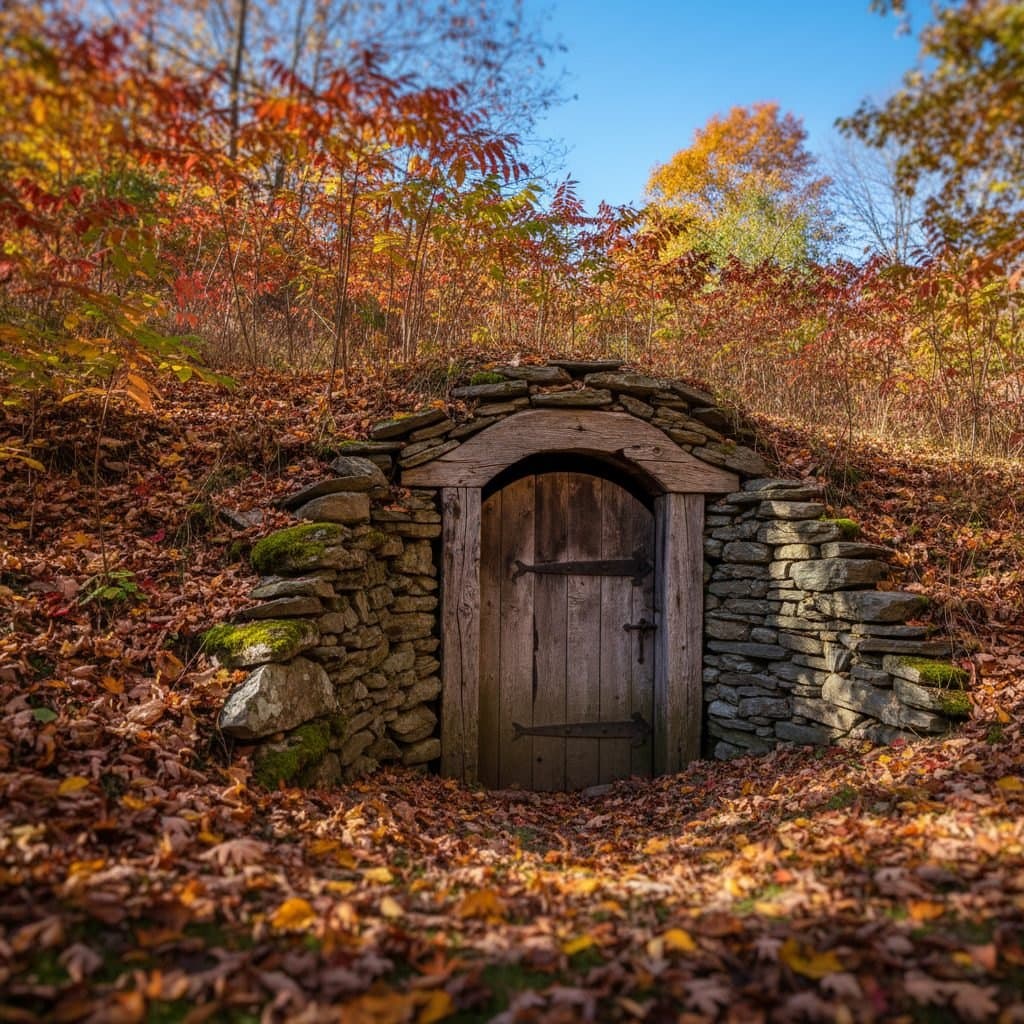
For growers seeking maximum storage capacity and thermal stability, a dedicated in-ground root cellar provides the most stable environment. These structures are typically built entirely underground or partially buried, providing superior insulation from external temperature swings. A well-constructed in-ground cellar can maintain a consistent 38°F to 42°F and 90% humidity, extending the storage life of many crops to six or even nine months. While more complex and expensive to build, often costing $1,000 to $5,000 depending on size and materials, their long-term benefits in food preservation are substantial. Such a cellar can easily store over 500 pounds of produce.
Design and construction considerations
The design of an in-ground root cellar requires careful planning for drainage, ventilation, and structural integrity. A common design involves a concrete or block structure, often 8 feet by 10 feet, buried at least 4 feet deep. The roof can be a concrete slab covered with 2 to 3 feet of earth, providing significant insulation. Proper drainage is essential, often achieved with a gravel bed beneath the floor and a perimeter drain to divert groundwater. Ventilation typically involves two 6-inch diameter pipes: one intake pipe extending to within 6 inches of the floor and one exhaust pipe near the ceiling. These pipes should extend 2 to 3 feet above ground level and be screened to prevent pest entry. Treat a fully buried cellar as a confined space: several hundred pounds of respiring produce consumes oxygen and gives off carbon dioxide, which pools at floor level. Prop the door and let the space air out before entering, never enter if the vents have been blocked, frozen shut or covered over winter, and do not let a child enter alone. Consider reading Root cellaring: storing the harvest without electricity for more detailed guidance on this method.
- Superior temperature and humidity control
- Large storage capacity, often hundreds of pounds
- Longest storage duration for most crops
- Increased resistance to pests and extreme weather
- Adds significant value to a homestead
Maintaining your root cellar
Once your root cellar is built, regular maintenance helps ensure successful long-term storage. Routine monitoring of temperature and humidity levels is necessary; use a reliable thermometer and hygrometer, checking readings at least once a week. Aim to keep temperatures between 35°F and 45°F, and humidity between 85% and 95%. If humidity drops below 80%, sprinkle water on the dirt floor or place a pan of water in the cellar to increase moisture. Conversely, if condensation forms, increase ventilation by opening vents for a few hours. This active management can extend the storage life of produce by several weeks, preventing issues like shriveling or mold.
Pest control and crop management
Pest control is another important part of root cellar maintenance. Rodents like mice and rats are attracted to stored food, so ensure all vents are securely screened with 0.25-inch hardware cloth. Inspect produce regularly, at least every two weeks, and remove any items showing signs of spoilage or disease, as fungal spores can spread rapidly in a humid environment. Store different types of produce separately when possible: apples give off ethylene, which accelerates ripening and decay in neighboring produce, and potatoes give off moisture and odors that taint apples. Keep potatoes in a dark corner, away from apples, to extend their storage life. Proper organization and cleanliness will significantly reduce losses.
- Monitor temperature and humidity weekly
- Inspect produce every two weeks for spoilage
- Ensure all vents are securely screened
- Store ethylene-producing fruits separately
- Clean the cellar thoroughly once per year
Comparison of root cellar types
Feature | Basement Corner | Buried Trash Can | Dedicated In-Ground |
|---|---|---|---|
Cost (materials) | $100 – $300 | $50 – $150 | $1,000 – $5,000+ |
Capacity | 100 – 250 lbs | 30 – 50 lbs | 500 – 2,000+ lbs |
Storage Duration | 3 – 6 months | 2 – 4 months | 6 – 9 months |
Temperature Stability | Good (45-55°F) | Moderate (40-50°F) | Excellent (38-42°F) |
Complexity | Low to Moderate | Very Low | High |
Humidity control: Maintaining 85% to 95% humidity keeps carrots from shriveling, which is the main cause of loss in dry storage.
Temperature range: A consistent temperature between 35°F and 45°F markedly slows sprouting compared with room-temperature storage.
Frequently asked questions
What is the ideal temperature for a root cellar?
The ideal temperature for most root cellar crops, such as potatoes and carrots, is between 35°F and 45°F. This range slows down respiration and inhibits sprouting, allowing produce to last for 6 to 9 months.
How important is humidity in a root cellar?
Humidity is extremely important, with an ideal range of 85% to 95%. High humidity prevents produce from shriveling and drying out over several months of storage.
Can I use any basement corner for a root cellar?
While any basement corner can be adapted, a corner with at least two exterior concrete walls is best. These walls provide natural thermal mass, keeping the corner cooler and more stable than the interior of the basement.
What kind of ventilation does a root cellar need?
A root cellar typically needs two ventilation pipes: one intake pipe extending to the floor and one exhaust pipe near the ceiling. For a small cellar, two 4-inch diameter pipes are usually sufficient to ensure adequate air exchange.
How much produce can a buried trash can cellar hold?
A standard 30-gallon buried trash can cellar can typically hold 30 to 50 pounds of produce, such as carrots, beets, or apples. This capacity is suitable for a small family’s winter supply for up to three months.
What crops store best in a root cellar?
Root vegetables like potatoes, carrots, beets, and parsnips store exceptionally well, lasting 6 to 8 months. Apples, pears, cabbage, and winter squash also do well, often remaining fresh for 3 to 5 months in the right conditions.