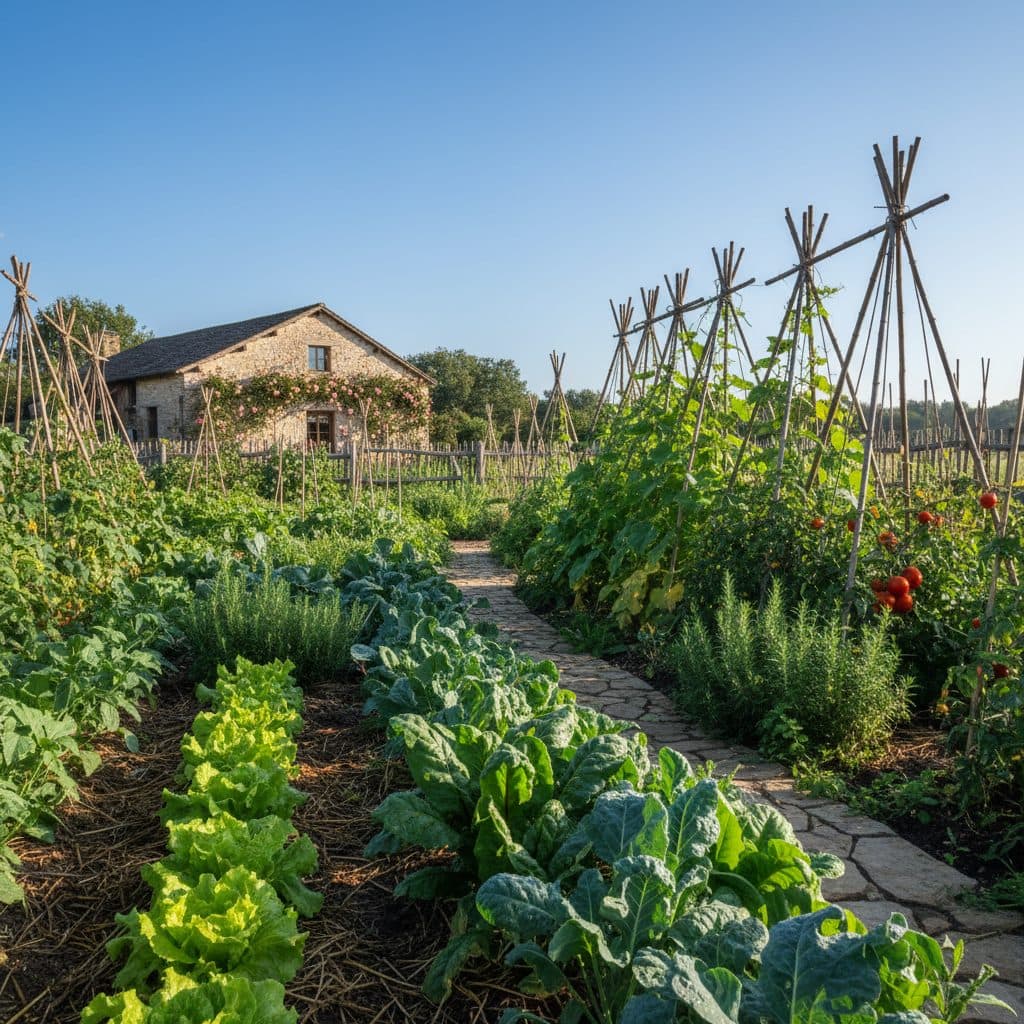
Key takeaways
- USDA Zones 9-10 offer a long growing season, often exceeding 300 frost-free days, allowing for year-round cultivation.
- Implement succession planting every three to four weeks for continuous harvests of popular crops like lettuce, radishes, and bush beans.
- Utilize cover crops such as crimson clover or hairy vetch in fall and winter to improve soil health and fix nitrogen for the following crop.
- Practice crop rotation over a three-year cycle to manage pests, diseases, and nutrient demands across different plant families.
- Select heat-tolerant varieties for summer planting for successful yields during temperatures that can exceed 90°F for extended periods.
- Incorporate living mulches and perennial edibles to reduce weeding, conserve soil moisture, and enhance biodiversity in your garden.
Quick answer: Zone 9-10 growers can extend harvests year-round by utilizing their long growing season with succession planting every 2-4 weeks, practicing crop rotation, and prioritizing soil health through organic matter and cover crops.
Growing in USDA Zones 9 and 10, which encompass much of Florida, the Gulf Coast, and Southern California, presents unique opportunities for year-round cultivation. Frost dates vary widely inside these zones, so check your own before planning. Along the Gulf Coast and in inland Zone 9a, the average last frost generally falls in February or early March and the first frost in late November or December; in Zone 10 frost is rare enough that growing runs effectively year-round. Either way the frost-free window is long, and your nearest weather station, available through a local extension office, will give you a far better figure than any zone-wide average. This extended period allows for multiple planting cycles and many kinds of crops, from cool-season greens to heat-loving tropicals.
Successful gardening in these warmer zones hinges on understanding local microclimates, managing intense summer heat, and strategically planning your planting schedule. By adopting practices like crop rotation and succession planting, growers can significantly increase their yields, maintain soil vitality, and enjoy fresh produce almost every week of the year.
Understanding Zone 9-10 climates and soil health
The Deep South, Gulf Coast, and Southern California share a common thread: a long, often humid, growing season with mild winters. In Mobile, Alabama, a Zone 9a city, the average annual minimum temperature is 20°F, while in Los Angeles, California, a Zone 10b city, it’s 35°F. This warmth means fewer worries about hard freezes, but more attention to summer heat and humidity. Soil composition varies widely; coastal areas often feature sandy soils with rapid drainage, while inland regions may have heavier clay loams.
building soil for continuous production
Building and maintaining soil health matters most for continuous production in these zones. Organic matter content should be a primary focus, aiming for at least 3% to 5% in garden beds. Incorporating compost, aged manures, and leaf mold annually helps improve soil structure, water retention, and nutrient availability. For sandy soils, adding 2 inches to 3 inches of compost each season can significantly boost moisture-holding capacity, reducing the need for frequent irrigation. The USDA Natural Resources Conservation Service (NRCS) recommends soil testing every three years to understand nutrient levels and pH, which ideally should be between 6.0 and 7.0 for most vegetables.
- Test soil pH and nutrient levels every three years.
- Incorporate 2 inches to 3 inches of compost annually.
- Utilize cover crops to add organic matter.
- Minimize soil disturbance to protect microbial life.
- Maintain consistent soil moisture, especially during dry spells.
January to March: early starts and cool-season crops
January in Zones 9-10 is often the coldest month, but it’s far from dormant. Many areas, particularly in Southern Florida and coastal California, experience average lows above 40°F, allowing for continued growth of cool-season vegetables. By mid-January, it’s time to start seeds indoors for crops like tomatoes, peppers, and eggplants. Tomatoes want six to eight weeks indoors and peppers and eggplants eight to ten, and none should go out until your local last-frost date has passed, which in inland Zone 9a is often not until March. Direct sowing can begin for hardy greens like spinach, kale, and Swiss chard, which thrive in cooler temperatures. For example, in Zone 10b, spinach can be sown directly from late December through February, yielding harvests in 30 to 45 days.
succession planting for continuous harvests
February and March bring warmer temperatures, signaling the peak of cool-season planting and the transition to spring crops. Direct sow carrots, radishes, beets, and peas every two to three weeks for continuous harvests. For leafy greens, consider planting a new batch of lettuce or arugula every 14 days to ensure a steady supply and prevent bolting as temperatures rise above 75°F. This is also an excellent time to plant potatoes, setting seed potatoes 4 inches deep and 12 inches apart. Utilizing living mulches can help suppress weeds and maintain soil moisture as the season progresses, especially for longer-season crops.
- Start warm-season seeds indoors by mid-January.
- Direct sow hardy greens and root vegetables in February.
- Plant potatoes in late February or early March.
- Implement succession planting for lettuce every two weeks.
- Prepare beds for spring transplants with fresh compost.
April to June: warm-season abundance and heat management
April marks the full swing of warm-season planting in Zones 9-10. With average daily temperatures consistently above 65°F, it’s safe to transplant all warm-season crops like tomatoes, peppers, eggplants, and squash. Direct sow beans, corn, cucumbers, and melons. For optimal growth, ensure your soil has been amended with 1 inch to 2 inches of compost.
succession planting and crop rotation strategies
As temperatures climb into May and June, focus on heat-tolerant varieties and continued succession planting. Plant new batches of okra, sweet potatoes, and southern peas every three to four weeks. Consider planting heat-tolerant lettuce varieties or switching to perennial edible greens like Malabar spinach or New Zealand spinach, which thrive in temperatures above 80°F. Crop rotation is critical during this period to prevent disease buildup and manage pests. For example, avoid planting tomatoes in the same spot for at least three years, rotating them with legumes or root crops. This practice interrupts the buildup of soil-borne diseases, though how much it helps depends on the specific pathogen and how long the break lasts.
- Transplant all warm-season crops by mid-April.
- Direct sow beans, corn, cucumbers, and melons.
- Plant heat-tolerant varieties of okra and sweet potatoes.
- Rotate crops to prevent disease and pest issues.
- Provide afternoon shade for sensitive plants when temperatures exceed 90°F.
July to September: managing summer heat and preparing for fall
July and August in Zones 9-10 are characterized by intense heat and often high humidity, with daily highs frequently above 90°F. This period can be challenging for many crops, but it’s not a time to stop planting. Focus on heat-loving vegetables like okra, sweet potatoes, and certain varieties of southern peas. Many gardeners in the Deep South use this time to plant a second round of these crops, ensuring a continuous harvest through early fall. Providing 30% to 50% shade cloth can significantly reduce stress on plants like tomatoes and peppers, extending their productivity by several weeks.
fall planting and soil rejuvenation
As September approaches, temperatures begin to moderate slightly, making it an ideal time to prepare for fall and winter gardens. Start seeds indoors for cool-season crops like broccoli, cabbage, kale, and collards, aiming to transplant them in late September or early October. Direct sow carrots, beets, and radishes. This is also a prime time to plant cover crops such as crimson clover or hairy vetch, which fix nitrogen through their root nodules and add organic matter as they break down. How much nitrogen reaches your next crop depends on stand density and on when you terminate the cover. Consider using syntropic chop-and-drop species to build biomass and improve soil structure during this transition.
- Focus on heat-tolerant crops like okra and sweet potatoes in July.
- Provide shade cloth for sensitive plants during peak summer heat.
- Start cool-season seeds indoors by mid-August for fall transplanting.
- Direct sow fall carrots, beets, and radishes in early September.
- Plant cover crops like crimson clover to enrich soil over winter.
October to December: winter gardens and soil protection
October in Zones 9-10 is often considered one of the best gardening months, with mild temperatures averaging 70°F and reduced humidity. This is the prime time for planting a wide array of cool-season vegetables. Direct sow **lettuce, spinach, kale, collards, mustard greens, and Swiss chard**. Plant garlic cloves 2 inches deep and 4 inches apart for a harvest next spring. In Zones 9-10, choose softneck types and pre-chill the cloves in a refrigerator for four to eight weeks before planting; without a cold period, garlic tends to produce a single undivided round instead of a bulb. Many growers in the Deep South can expect to harvest fresh greens well into December, often with minimal frost protection.
winter protection and cover cropping
As November and December arrive, temperatures cool further, but rarely drop below 30°F for extended periods. Continue planting hardy greens and root crops. Consider planting a final round of radishes or turnips, which can mature in as little as 25 days. For areas that might experience a brief dip below freezing, having row covers or frost blankets on hand can protect sensitive crops. This is also an excellent time to establish nitrogen-fixing trees or shrubs as part of a long-term garden plan. Cover crops, if not already planted, should be sown by early November to establish before the coldest weather to protect soil from erosion and add organic matter.
- Plant a wide variety of cool-season greens in October.
- Sow garlic cloves for a spring harvest.
- Continue succession planting hardy root vegetables.
- Utilize row covers for frost protection below 30°F.
- Establish cover crops by early November for soil improvement.
Seasonal Crop Suitability for Zone 9-10
Season | Typical Temperature Range (°F) | Recommended Crops | Key Considerations |
|---|---|---|---|
Winter (Dec-Feb) | 35-65 | Broccoli, Cabbage, Carrots, Kale, Lettuce, Spinach, Garlic | Mild frosts possible, use row covers below 30°F |
Spring (Mar-May) | 55-85 | Tomatoes, Peppers, Beans, Corn, Cucumbers, Squash, Potatoes | Transition from cool to warm, succession planting |
Summer (Jun-Aug) | 75-95+ | Okra, Sweet Potatoes, Southern Peas, Eggplant, Melons | Intense heat, high humidity, provide shade |
Fall (Sep-Nov) | 60-80 | Broccoli, Cabbage, Carrots, Beets, Lettuce, Radishes, Swiss Chard | Ideal growing conditions, prepare for winter crops |
Soil Organic Matter: Aim for 3% to 5% organic matter in your garden soil to improve water retention and nutrient availability, especially in sandy coastal areas.
Cover Crop Benefits: Crimson clover fixes nitrogen through its root nodules and adds organic matter when terminated, reducing how much fertilizer the following crop needs.
Frequently asked questions
What are the average frost dates for Zone 9-10?
Frost dates vary widely inside Zones 9-10, so there is no single answer. Along the Gulf Coast and in inland Zone 9a, the average last frost is generally February or early March and the first frost late November or December. In Zone 10 frost is rare enough that growing runs effectively year-round. Look up your nearest weather station through a local extension office rather than relying on a zone-wide figure.
How often should I succession plant in Zone 9-10?
For continuous harvests of fast-growing crops like lettuce, radishes, and bush beans, succession plant every two to four weeks. This ensures a steady supply and prevents all plants from maturing at once, so the same bed keeps producing instead of sitting empty between crops.
What are good cover crops for winter in Zone 9-10?
Excellent winter cover crops for Zone 9-10 include crimson clover, hairy vetch, and Austrian winter peas. These legumes fix nitrogen in their root nodules and improve soil structure over the cooler months.
How do I manage intense summer heat for my plants?
To manage intense summer heat, provide 30% to 50% shade cloth for sensitive plants like tomatoes and peppers when temperatures consistently exceed 90°F. Ensure consistent watering, aiming for 1 inch to 1.5 inches of water per week, and use thick mulches to keep soil cool and moist.
Can I grow tropical fruits in Zone 9-10?
Yes, many tropical fruits thrive in Zone 9-10, especially in Zone 10b and warmer parts of Zone 9. Citrus, avocado, mango, and certain varieties of banana can be successfully grown, often yielding fruit for several months of the year.
References
- USDA Natural Resources Conservation Service (2024). USDA Natural Resources Conservation Service.